The Power Of The Resurrection
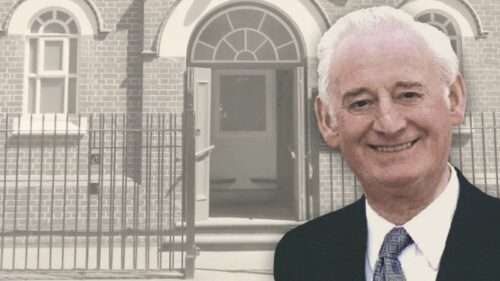
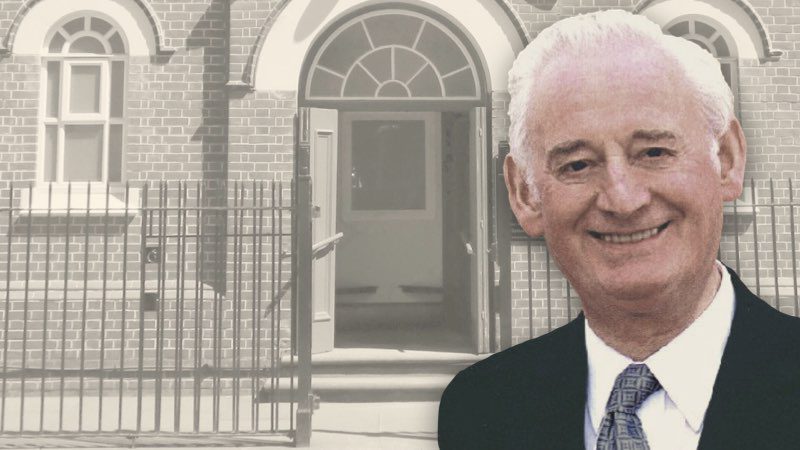
[Posted by permission. Bethel Strict Baptist Chapel.]
Sermon preached at Bethel Chapel, Luton, by Mr. B. A. Ramsbottom, on Lord’s day morning, 4th April, 2021 (Easter Sunday)
“And with great power gave the apostles witness of the resurrection of the Lord Jesus: and great grace was upon them all”—Acts 4:33
Have you ever noticed that throughout the Acts of the Apostles, whenever the apostles themselves were preaching, the theme was always the resurrection? You have it when they spoke to the priests concerning the raising of the lame man. You have it in the preceding chapter and in this chapter when they preached to the people. You have it in the following chapter: “Him hath God exalted … to be a Prince and a Saviour.” And you have it all the way through: the resurrection, the vital theme of the preaching of the apostles.
Now I know what some of you may say to me: But didn’t Paul himself, the great apostle, say, “I determined not to know any thing among you, save Jesus Christ, and Him crucified”? Now beloved friends, there is no contradiction there. When we think of this word, resurrection, when we consider it in all its simplicity, it does not just mean that someone lives, but it means that first he has died, and then he has been raised again. So let us be very clear: the preaching of the resurrection contains as its glorious foundation the preaching of Christ and Him crucified.
“The Saviour died, and by His blood
Brought rebel sinners near to God.”
He died; He was buried; He rose again; and we rejoice today, that “The Lord is risen indeed.” “Vain the stone, the watch, the seal.” As the apostles with great power gave witness to the resurrection of the Lord Jesus, O that we might feel a little of that power in our midst and in our hearts today, and that remarkable word that follows: “And great grace was upon them all.” If only we might experience a little of that great grace!
“With great power gave the apostles witness of the resurrection of the Lord Jesus.” And why did they do it? And why must they do it? Because they were witnesses of it. Of course, this is speaking especially of Peter and John, and they were witnesses. A witness must testify faithfully of something that he knows, and that is why Peter and John were able with great power, with divine authority, to bear this witness. They had been present at Calvary. They had seen their Lord and Master crucified. They had seen Him buried in the tomb of Joseph of Arimathea. And after He had risen from the dead, He had appeared to them. He had spoken to them. He had appeared to Peter. He appeared to all the apostles. He appeared to many witnesses. He appeared to five hundred at once. So they could bear witness to the fact. Whatever had been happening in the previous chapter (chapter 3) – the way this power had been made known in the curing of that impotent man who could not walk, the reason they had given to the priests – this was the thing that the priests themselves could not deny and they had to confess it. They said the whole of Jerusalem knew it (verse 16).
So the apostles could speak with great power of this simple and yet vital point, the actual fact that the Lord Jesus was risen from the dead, that He did live, that they had seen Him, they had spoken with Him. Never forget that: there is a fact – no other religion has it – and that fact lies in that one place: the empty tomb. “Come, see the place where the Lord lay.” “Vain the stone, the watch, the seal.” “The Lord is risen indeed.”
“With great power gave the apostles witness of the resurrection of the Lord Jesus.” But secondly, they spoke with great power and authority because they knew what it meant, what was in it, what was the doctrine of it. Well, of course one or two things, and they are important things, and important to you and me this morning, two thousand years later. He was “declared to be the Son of God with power … by the resurrection from the dead.” The dear Lord Jesus had made these claims that He was the Son of God. He had confirmed them so far by His miracles, but He was going to confirm the fact of His Godhead by His resurrection, and as He rose from the dead, there was that clear evidence that He was who He claimed to be, the Son of God from all eternity.
Then also, what of the work that He came to accomplish! and what a work it was, and how you and I have a personal interest in it: the putting away of sin by the sacrifice of Himself in matchless love to His unworthy, sinful people! Now His resurrection was His Father’s eternal confirmation that His beloved Son had accomplished all for which His Father had sent Him, and that all for whom He died were saved with an everlasting salvation. O the Father’s seal! What about the Lord Jesus? He “was delivered for our offences, and was raised again for our justification.” As we have often said, if a person was cast into prison, he was paying a debt for another, when would that other rejoice? He would be thankful that his friend was suffering for him in prison, but wouldn’t he rejoice when the prison doors opened and his friend came forth! The debt is paid, the victory won. And then what a pledge of the resurrection of all God’s people to everlasting life in that last great day. “Christ the firstfruits; afterward they that are Christ’s at His coming.”
“With great power gave the apostles witness of the resurrection of the Lord Jesus.” But then of course they bore witness to this: that “The Saviour lives no more to die!” They preached a living Saviour. We preach Christ crucified, but we do not preach a dead Saviour. We preach a Saviour who in love laid down His life and died, but we do not preach a dead Saviour. We preach a living Saviour. I do like that little phrase; it comes in the Epistle to the Hebrews: “After the power of an endless life” (Hebrews 7. 16). Comparing the Lord Jesus with the priests of the ceremonial law, they were “after the law of a carnal commandment,” but Christ, “after the power of an endless life.”
“The Saviour lives no more to die!” And this living Saviour can be known, and He can be loved, and He can be worshipped. We think of Him at the Father’s right hand, an almighty, merciful, faithful, gracious High Priest.” “But this Man” – this glorious Man – “because He continueth ever” – “the power of an endless life” – “hath an unchangeable priesthood. Wherefore He is able also to save them to the uttermost that come unto God by Him, seeing He ever liveth to make intercession for them.” If you and I are born again of the Spirit, if you and I are rightly taught our need, it will be this living Saviour we shall seek, and this living Saviour we shall find, and this living Saviour will be all our hope for time and for eternity. We have no other hope, and surely that is the great point with you and me this morning: have we sought, have we found this living Saviour, and have we been brought to rest all our hope upon Him?
“‘None but Jesus! ‘None but Jesus!
From His blood” – we might say, from His death and resurrection – “their hopes arise.”
“With great power gave the apostles witness of the resurrection of the Lord Jesus.” And beloved friends, they knew the power of His resurrection. It is a mercy if you and I do. Surely this Easter morning that should be our great desire, that we might know something of the power of His resurrection. “That I may know Him, and the power of His resur- rection.” It is that power of the resurrection that first quickens a sinner into life and causes him to live. It is the power of His resurrection which makes Himself known, the power of His resurrection in forgiveness and in sanctification, and in keeping, and in helping, and delivering, and bringing safely through. Whatever hard causes you have this morning – whether you are listening in chapel or listening at home over the relay, have you any hard causes? Well, you say, sin and self and unbelief and hardness of heart, and then all these burdens in providence. This is the risen Saviour speaking: “The cause that is too hard for you, bring it unto Me, and I will hear it.”
This risen Saviour speaks, and one thing He speaks is this: “Because I live, ye shall live also.” What a word He spoke to John on the Isle of Patmos, when John was an aged man, when John could no longer preach – the same John of this verse in Acts chapter 4; he was only a young man here. We think of all the restrictions of the Covid, just as that aged apostle had to be separated from his beloved flock. For the testimony of Jesus he was exiled on the Isle of Patmos. It was the Lord’s day, the resurrection day. He was all alone. He was isolated there. And what a glorious appearance of the risen Saviour – this One he knew and loved on earth, this One he had preached with such great power here – and his beloved Saviour had not forgotten. I wonder if John ever had a better day. He had such a view. He had known the Lord Jesus on earth, but now he saw Him in all His glory, and then he heard His voice: “Fear not … I am He that liveth, and was dead; and, behold, I am alive for evermore, Amen; and have the keys of hell and of death.” And to a child of God that means one thing: Christ holds the keys, and He has locked the gates of hell for ever against His people. As every sinner redeemed by blood comes from the grave, He there opens the gates of heaven for them.
“With great power gave the apostles witness of the resurrection of the Lord Jesus.” But I take it, beloved friends, that this word does not mean just they preached about the great power, but in their actual preaching, that preaching was attended with great power. The Lord was with them. The Lord was blessing them. There are so many wonderful things in this chapter. They were forbidden to preach, and yet with great power they continued to preach. They had the hosts of hell against them, and yet they all prayed together. There was great power. There was that earthquake which shook the place. They had an immediate answer to their prayers. They had the whole of the Jewish Sanhedrin, all the scribes, the Pharisees against them, but the risen Saviour was with them, and they were experiencing His power. As they preached, great power attended their preaching.
Now there is a solemn note here. Today surely this is what is lacking in our preaching, and in the preaching of our chapels, and in the preaching of the truth throughout the earth: that great power that the apostles knew, and which was known at the time of the glorious Reformation and the Evangelical Revival, and then afterwards in the nineteenth century in various places. This is the sad thing which we seem to lack today. I believe in our chapels the same truths are preached in measure that Gadsby, Warburton and Kershaw preached, but where is the power?
When I first went out to preach, I went to preach at the little chapel in Manchester. There were two chapels. This was Zion Chapel in Thirlmere Street, where Thomas Emery was for years, and then Mr. Lythgoe. When I got there, there was a congregation of about ten, and three of them were in their nineties. They told me during the lunch interval and after the service that they were part of A.B. Taylor’s congregation. I could not believe it, but I tried to work it out, and they would have remembered Mr. Taylor (1803-1887). He had a thousand in the congregation and over two hundred communicant church members. A godly old lady in her nineties, perhaps on a later occasion when I went, said, “Can I tell you something? Mr. Taylor did not preach any differently from you and the ministers today, but,” she said, “O the power that attended his preaching!”
So beloved friends, there is a point here for our prayers, that the best of preaching without the power attending will not avail, and the feeblest statement of divine truth, attended with power, will do the deed. We think of the texts on those Easter calendars which were distributed in the district this last week. If one person reads one of those texts and if this power that is recorded here in Acts chapter 4, this power from heaven appears, salvation’s work will be accomplished. There is a word, and it is humbling but very encouraging: “We” – preachers – “have this treasure in earthen vessels.” That is what we are: poor, earthen vessels. “That the excellency of the power may be of God, and not of us.”
“With great power gave the apostles witness of the resurrection of the Lord Jesus.” O may we be favoured to know something, if only a little, of this in our day! But then what an amazing word follows: “Them all.” Not everybody is an apostle; not everybody is a preacher. “Them all.” “And great grace was upon them all.” We have the same word: “Great power”; “great grace.” That was the effect of the preaching. The preaching came with great power into their hearts, and also into their lives, so they knew that great grace which flowed from that great power, and it was all from the risen Saviour. “For it pleased the Father that in Him should all fulness” – all the fulness of great grace – “should all fulness dwell.” You know the way to know anything of that great fulness. It is to be taught by the Holy Spirit our emptiness. “Empty and bare I come to Thee” – a mighty sinner and a full Christ.
“Great grace was upon them all.” I must say, I think I was perhaps helped to enter a little, thinking about the text this morning, into the beginning of it. But this great grace resting on all the believers who were there – it seems a theme almost beyond us. But you just see it here, the great grace. They had been dreadfully treated by the Jewish authorities, but they did not seem to bother about that or mention it in this chapter.
“Great grace was upon them.” What great grace they showed in prayer! How they prayed! They saw the greatness of God. They said, “Lord, Thou art God, which hast made heaven, and earth, and the sea, and all that in them is.” They had not any doubt He could do great miracles for them. What great grace they showed, and what courage they showed, and the wonderful way they were led in prayer, and they expected an answer to their prayer, and they received that answer immediately. “When they had prayed, the place was shaken.” That great power was shown, and then you see that great grace in them. “They were all” – we have that little word – “They were all filled with the Holy Ghost.” And the union there was among them! “The multitude of them that believed were of one heart and of one soul.” And you see how they were all willing to help one another, whatever it cost them.
“Great grace was upon them all.” Well, there is something here for us to think about. We need grace in forgiveness, grace in cleansing in the Redeemer’s blood. We need grace in sanctification, and we need that grace daily, grace to humble us, grace to keep us, grace that we might seek the honour and glory of God, grace to deliver us, and so you might go on, and you could meditate all afternoon on the various aspects of grace. O but the wonderful thing that stands out: all this grace, wherever it is found, it must be through the risen Saviour. If you and I this morning feel our lack of grace, and surely we do, then the only place we can find it is in the Person of a risen Saviour. But the wonderful thing is, He delights to give this grace. We have that beautiful word: “He giveth more grace.” We need it; He has it to give.
I have often reminded you of the godly minister who in the eighteenth century was offered a reward by the British government, and the prime minister asked him what he would like more than anything else in return. He said, “There is only one thing: more grace.” Now it is an easy thing to repeat that; it is a different thing to mean it. May we this morning be found seeking grace in the risen Saviour.
So this word – doesn’t it speak to you, and doesn’t it speak to me! And aren’t there the things here, as we go home, to pray for – to pray for more of the Spirit’s working with power in our hearts and lives! We are so weak so often in the things of God, so helpless. To ask for that power, and then to pray for it for our preachers as they go into the pulpit, that the Lord will bless them, not with power only, but with great power. We read this morning, “The Lord … confirming the word with signs following” (Mark 16. 20). That is great power.
And then this great grace – well, don’t we need it in our churches! There seem to be so many distressing things at present. May we be helped to pray for great grace to abound amongst us, and throughout the earth, but especially that we might know – we trust we do know something of grace in our hearts and in our lives; we are thankful for it – O but may we have that spirit of prayer that we might know more grace, and then what a difference there would be! We would be humble at the risen Saviour’s feet. He would be everything, and there would be a spirit of forgiveness, of love abounding towards one another, especially love towards the risen Saviour Himself.
“With great power gave the apostles witness of the resurrection of the Lord Jesus: and great grace was upon them all.”
The Saviour lives no more to die!
He lives, the Lord enthroned on high!
He lives, triumphant o’er the grave!
He lives, eternally to save!
He lives, to still His people’s fears!
He lives, to wipe away their tears!
He lives, to calm their troubled heart!
He lives, all blessings to impart!
He lives, all glory to His name!
He lives, unchangeably the same!
He lives, their mansions to prepare!
He lives, to bring them safely there!
S. Medley
Now to the power of God supreme
Be everlasting honour given;
He saves from hell (we bless His name),
He calls our wandering feet to heaven.
Not for our duties or deserts,
But of His own abounding grace,
He works salvation in our hearts,
And forms a people for His praise.
’Twas His own purpose that began
To rescue rebels doomed to die;
He gave us grace in Christ His Son,
Before He spread the starry sky.
Jesus the Lord appears at last,
And makes His Father’s counsels known;
Declares the great transactions past,
And brings immortal blessings down.
He dies! and in that dreadful night
Did all the powers of hell destroy.
Rising, He brought our heaven to light,
And took possession of the joy.
I. Watts -8-
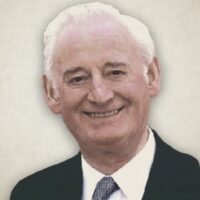
Benjamin Ramsbottom (1929-2023) was a Strict and Particular Baptist preacher. In 1967, he was appointed pastor of the church meeting at Bethel Strict Baptist Church, Luton, Bedfordshire, a position he held for fifty-five years.