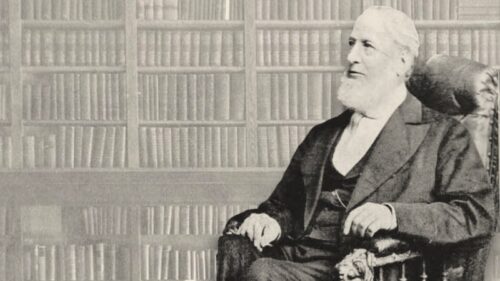

The Life And Ministry Of John Gowring
The Gospel Magazine 1880:
Grace Triumphant; Or, Two Or More Victors Through The Blood Of The Lamb
We never remember to have taken up the pen before with the reminder that two of our oldest and most valued friends had just passed away within one day of each other, and that a third has for some time been so ill as for us by every post to expect to hear that he had been called home likewise. How are the ranks of our old friends and supporters thinning, and how the fact forcibly reminds us of the near approach of our own summons! The Lord in mercy grant that it may find us both in a waiting and a willing posture, “looking for that blessed hope and the glorious appearing of the great God and our Saviour Jesus Christ.”
We shall now, as the Lord may enable, speak a little of the two departed friends to whom we have just alluded. The name of the first will be familiar to most of our readers, inasmuch as articles from the pen of THE REV. J. W. GOWRING very frequently appeared in these pages. Our personal friendship began very soon after our first connection with the GOSPEL MAGAZINE. In consequence of the loss of sight, he had just before resigned his curacy at Harewood, under the incumbency of the Rev. RICHARD HALE, who continued his attached and devoted friend up to the period of his own removal by death. It was our privilege, through the introduction of Mr. GOWRING, to pay Mr. HALE a short visit at Harewood, and from himself to learn the esteem and regard in which he held his late helper.
We have but little doubt that to the clear grasp of truth, and his steadfastness and outspokenness in it, as far as Mr. HALE was concerned, Mr. GOWRING, under God, owed instrumentally that bold, decided, and most unflinching stand in and for the truth which he himself was enabled to take in the very outset of his ministry, and by divine grace was strengthened and emboldened to continue throughout his chequered, eventful, and most honourable career.
Unless their thoughts have been directed and their attention called to the fact, many a young servant of the Lord may probably overlook the wise and gracious appointments of divine Providence, in that the character of their ministry has been formed under some well and deeply-taught servant of the Most High. How, as they have listened to the pulpit testimony of such, and scrupulously watched the dealings of God in regard to them—and especially as they have been led to contrast both the testimony and the leadings with other men—have their own hearts been encouraged, and, little by little, their own minds established and emboldened in and for “the truth as it is in Jesus.”
If ever in one instance more than another we saw the truth of a long-cherished thought exemplified, it is in that of dear GOWRING. For very many years has the thought of which we speak prominently occupied the mind of one with whom we are personally most familiar. That thought was this: “Take care,” says God, “of My truth, and I will take care of you.” The same idea has continuously presented itself in the annexed couplet—
“Make you His service your delight,
Your wants shall be His care.”
And we are as sure as we are of our own existence that this shall prove a verity in the experience of the Lord’s family—His ministering servants especially.
Whilst speaking publicly of our dear brother, since his call home, we made the remark that we never knew one who was more justly entitled to sign himself, “Your faithful friend and brother,” than J. W. GOWRING. He was faithful in the truth and to the truth. There was no vacillating nor cringing, no clipping nor paring down, nor fawning nor flattery, no courting the smiles nor shunning the frowns of his fellow-men. He was a faithful steward of his Master. As he was taught the truth himself, so in turn he sought to teach others. “THE TRUTH! THE TRUTH!” was his favourite word. “IN THE TRUTH,” as he was wont so continuously to express himself, resounds through our ears at the moment of writing. That he did abide by the truth—that he “shunned not to declare the whole counsel of God”—that he was “faithful to Him who had called him”—may be presumed in that he never received preferment in the Establishment of which he formed so honourable a member, and within whose pale he so zealously laboured for some forty years.
There was no curry-favour with Mr. GOWRING, nor the semblance of compromise with a view of obtaining temporal advancement. He came out as eleventh wrangler at Cambridge; but, apart from his appointments as afternoon lecturer at St. John’s, Bermondsey, and subsequently as evening lecturer at St. Giles’s, Cripplegate, he never was made incumbent. He lived and died a curate; and (speaking after the manner of men, and taking into consideration the intensity and arduousness of his labours) his being passed over, in regard to promotion, was highly discreditable to those in authority, or who had Church appointments at their command. His infirmity with respect to blindness was no reasonable cause for his never having received promotion. As curate of Kennington, he virtually had sole charge of a large district. His zeal, earnestness, and indefatigable labours, notwithstanding his want of sight, would, by comparison, place the vast majority of young men far, far in the shade. Not merely would he take two and three full services on the Sunday, but the week-evenings were rare in which he had not some public engagement or other. Moreover, the sick and the suffering were sure of a pastoral visit from this self-denying servant of the Most High. In fact, we can with truth say, we never met his fellow for actual labour.
The late S. A. WALKER and the now venerable Dr. HEWLETT, we are quite aware, made it a matter of conscience never (if possible) to refuse an invitation upon their Master’s service. Readiness to go hither or thither upon anyone of His errands was proverbial with them. But this as thoroughly applied to our departed friend. Mr. GOWRING would never say “no” to a call, if by any possibility he could comply. He was to be seen at all times, in all places, and in all weathers. We have often contemplated his movements with the utmost astonishment, and have admired the condescending and most gracious care which the Lord exercised over His servant, in that, amid all the crowded thoroughfares of the great London, and his numerous journeys, both far and near, by railway, no accident or untoward mishap has ever befallen this active and energetic servant of the Lord.
But, apart from his ministerial and parochial duties, Mr. GOWRING was raised up of God to do a most wonderful work. It fell to his lot to prepare the copy and revise the proof-sheets of the Bible for the blind, and likewise the embossed Prayer-book for the use of those who, in common with himself, were deprived of the great boon of sight. Now, what this preparation of the copy and revision of the proof-sheets entailed upon both Mr. GOWRING and his most devoted wife, none but eye-witnesses can imagine. Suffice it to say, that at all times and all hours, copy or proof being wanted, Mr. GOWRING made it a matter of conscience at once in the promptest manner to respond. Perhaps he had just come in from paying a sick visit, or taking a mid-day service at some asylum, police-station, or poor-house, or possibly had just returned from his usual week-evening service, or from preaching for some friend in the City or elsewhere. A messenger from the printer is in waiting. Copy or proof is wanting; and, in spite of previous labour or fatigue, copy or proof must be had. The messenger must by no means be sent away without the needed material, cost what that material may by way of toil at such juncture.
We repeat that only eye-witnesses could conceive of what this work entailed, both upon Mr. and Mrs. Gowring—the one reading, the other comparing. The whole Bible was gone through again and again, and certain parts and portions were remed and reprinted repeatedly. And how, it may be asked, was this dear servant of God compensated for this his labour? To the best of our recollection, all that he ever received for this particular service, extending as it did over some years, never exceeded some five-and-twenty pounds! We are positively ashamed to notify the fact. At one time we wrote an article upon the subject, but our departed brother would not allow of its insertion. No; he was content to leave himself in his blessed Lord and Master’s hands. No mind was ever more imbued with the conviction than was his, “Your heavenly Father knoweth that ye have need of all these things;” and it was his delight to speak of, listen to, revel in, the providential as well as the gracious dealings of the Lord. As we write we seem to see him, with his netting in his hand, looking up with his wonted smile and his animated expression, either telling of or responding to some fresh proof of the love, the tenderness, the faithfulness, the all-sufficiency of Him of whom he was ever delighted to hear or speak. Nothing was too minute—no event or circumstance, interposition or deliverance, in which the interest of a fellow pilgrim or the glory of the Master was involved—but always had the attentive ear, the smiling recognition, and the grateful response of our departed brother.
In spite of his affliction, without exception he was among the most cheerful and animated of men. We can with the utmost truth testify that we never heard the semblance of a murmur or the shadow of repining fall from his lips. An hour or two in his company would pass ere one was aware.
The Word! the Word! oh, it may be said to have been his all-engrossing theme! If the despised Coalheaver were called “the walking Concordance,” sure we are that the blind clergyman might strictly claim companionship. Whatever passage might be named, dear GOWRING would appear to have well thought over it. His range was from Genesis to Revelation, and back again from the one to the other.
And then, notwithstanding his infirmity, and amid all the turmoil and distracting influences of the great London, how calm, how peaceful, how staid was his general tone! Indeed, he was a striking illustration of’ that precious portion: “Thou wilt keep him in perfect peace whose mind is stayed on Thee, because he trusteth in Thee” (Isaiah 26:3).
Moreover, the reader will please to consider that we speak, not simply of the occasional or the short period; but we are testifying of that which embraces times and circumstances extending over nearly forty years.
In support of one of our earlier observations, “Take care of My truth, and I will take care of you;” although, as we have said, Mr. GOWRING never received promotion at the hands of his fellow-men, yet his God took special care of him. His was the hand-basket portion, but it was not the less sure. “The barrel of meal wasted not, nor did the cruse of oil fail, according to the word of the Lord which He spake by Elijah.” Our departed brother found it as verily a verity as did the prophet and the widow. He occupied the house from which he was called to his eternal inheritance for nearly the whole period of which we have spoken, and for many years—we know not how many—the rent of the said house was regularly paid; but the occupant knew not by whom, but the Lord knew; and, whoever it was, has had, or shall have, the “Inasmuch,” &c.
We have sometimes thought that we did our brother an injustice, and that in this way. Considering the unremitting devotedness of his loved and loving wife—the extent to which he had to look to and depend upon her, even to the cutting up his food and so on—we have thought, “If the Lord should ever see fit to remove her, what, alas! would become of her poor husband?” Now, the entertaining such a thought was virtually tempting the Lord, in order to test and prove what He could and would do. It pleased the Lord, some five or six years ago, to lay His afflictive hand more heavily than He had previously done upon Mrs. GOWRING; and never shall we forget our visit to this deeply-tried couple. The scene was touching in the extreme. We made some notes immediately after the visit, descriptive of the interview. These notes we have mislaid. However, we remember, under this new phase of trial, that, whilst the wife wept, there was still upon the part of the husband that special something which implied the prevailing feeling of his heart to be, “It is the Lord; let Him do as seemeth Him good.” As aforetime, there was the entire absence of the veriest semblance of murmuring or fault-finding. It was verily, “Let me fall into the hands of the Lord, for His mercies are great; and let me not fall into the hands of man.”
At our next visit the occupant of the sick-bed was gone. By it sat the bereaved and desolate husband—desolate, did we say? No, not desolate; for his whole bearing bespoke, not merely supernatural support and upholding, but a supernatural companionship likewise. In the whole course of our parochial experience, we never remember such a scene as that retired chamber presented. The sun was shining very brilliantly that forenoon. Facing it sat our dear friend. His whole countenance was lighted up, not with a calmness and placidity merely, but with a kind of heavenly radiance. It surpassed everything we ever saw, as far as memory serves. It was beautiful. With the exception of the surroundings, it seemed to us to be a renewal of the patriarchal scene: “I HAVE WAITED FOR THY SALVATION, O LORD,” was the practical language of the picture then and there presented. Deeply do we regret forgetfulness of the words that were spoken; but perfectly do we remember that they were significant of the same peace, calmness, passive resignation—yea, more, unmixed and unqualified acquiescence—in the will and pleasure of his ever-gracious Lord and Master. It was a lovely spectacle. Practically the position of our dear friend was, “And now, Lord, what wait I for? My hope is in Thee.” There seemed to be a blessed blending of Job’s “All the days of my appointed time will I wait, till my change come,” with Simeon’s “Now, Lord, lettest Thou Thy servant depart in peace, according to Thy word, for mine eyes have seen Thy salvation.”
When speaking to a dear relative of this our last interview with our departed brother, and his appearance on the occasion, she said it reminded her of what she and a since glorified sister in the Lord once witnessed. Mr. GOWRING was preaching at St. David’s Holloway, upon a certain evening. Of a sudden the gas “as raised; he was at the time occupying the pulpit. He was so engrossed and animated with his subject that, as the gas shone upon his countenance, it was lighted up with, as it were, a supernatural brightness. Both our informant and her companion were greatly struck with the brilliancy of his countenance as he gave utterance to the truths touching the King in which his whole soul revelled.
Since writing the foregoing, the annexed letters have come to hand. The first is from his loved and devoted sister. It was from her we heard of the departure of her now glorified brother. The reader will, we are sure, admit that her testimony quite bears out all that we have said respecting our departed friend. When contemplating his illness, as we have done, for the last three or four years, we have deemed it one of the severest tests to which so active and energetic a man could possibly be subjected. For so many, many years of intense daily labour to be followed by such absolute cessation from all toil or occupation, was evidence and proof indeed of what the grace and strength of God could effect, coupled as that cessation from labour was by the most entire submission to, and passive, placid falling in with, the will and pleasure of the Most High. We have been wont to think, in connection with our dear friend’s last and long illness, that he was to be presented to the Church and the world as a pattern and example of both WORKING and WAITING.
Here is Miss GOWRING’S letter:—
DEAR DR. DOUDNEY,—My dear brother’s funeral took place on Saturday, at Norwood-Cemetery. We were obliged to have it soon on account of the great heat of the weather. My brother’s was an active, willing service, while health and strength were spared; but. for the last three years it has been a life clouded by disease, but borne with such patience and complete resignation to the will of God that only the sustaining grace of God could have imparted. During those years of constant companionship I have never heard a murmur from him. He was very silent, but much passed that assured me he held sweet communion with his God and Saviour—many little things that are sweet to my own memory, but would scarcely bear repetition, even if I could give his exact words.
From the fifteenth of August, when he was taken much worse, it was such complete exhaustion and weakness that there was no power to say much. It was a passing away from sin, sorrow, and weariness to everlasting happiness; “absent from the body, present with the Lord.”
The text which I have chosen for his memorial card (which will be forwarded in a few days) appeared to me to express his state of mind during his long illness, and the Source from which he derived that calm waiting his call home. It was the last chapter I read to him (Isaiah 26) that he made any remark on; after that, only a Psalm or hymn. I am sorry I can help you no more, but it was a patient waiting on the Lord more than any outward expression. Excuse this hurried note.
Believe me, yours very sincerely,
Eliza Gowring
September 6th, 1880.
The annexed is from a mutual friend, the incumbent of St. Thomas’s, Lambeth. The Rev. J. R. STAREY writes as follows:—
My DEAR DR. DOUDNEY,—Can you recommend me a curate, sound in the faith, holding the distinguishing doctrines of grace? You will greatly oblige me. I find the greatest difficulty in obtaining such an assistant-stipend, one hundred and fifty pounds.
You have of course heard of our old friend’s peaceful departure to his heavenly home—I mean the Rev. J. W. GOWRING. I suppose we are two of his oldest friends. I first made his acquaintance at the Rev. R. SHUTTE’S church, for we were the only two London ministers who were privileged to preach at St. Faith’s. For thirty years I have known Mr. GOWRING, and it was my solemn duty on Saturday last to read the Burial Service of our Church—so expressive when at the open grave of a believer. On Sunday I preached from a text much laid upon my mind. Some would call it a funeral sermon, from Revelation 14:13, for our dear brother was well known to my congregation. The late Mr. SNEPP lately preached for me. One feels sad at the loss of the faithful witnesses. I can quite endorse Joseph Irons’ sermon on Isaiah 22:5, as it appears in this month’s Magazine. We live in fearful times! May the Lord raise up and thrust more labourers into His vineyard, who will “not shun to declare all the counsel of God.”
With Christian love, believe me, ever yours in Gospel bonds,
R. Starry
September 6th, 1880.
Speaking of the departed brother, the City Press of September 4th says:—
The Rev. John William Gowring, B.A., died at his residence in the Stockwell-road on Tuesday. The late rev. gentleman (who was afflicted with loss of sight) was one of the most faithful ministers of the Church of England of the present century. He was a Cambridge man, and was eleventh wrangler. He was for a long term of years one of the curates of Kennington parish. During the later part of his time he held regular services in the large school-rooms in Bolton-street. In fact, it was a kind of district church. It was here that the late Rev. George Doudney (of Charles chapel, Plymouth), when officiating for Mr. Gowring, said, when speaking some great truths in a humble manner. “You will think me a strange kind of Churchman.” It was here too that the same Mr. Doudney “crowded the sanctuary with churchmen and dissenters, where he spoke to them goodly words,” while Mr. Gowring, the “blind preacher” was taking duty at Plymouth. While Mr. Gowring was at Bolton-street a gentleman wrote to him, offering, in consideration of his blindness, to read prayers for him, thinking it would be a relief. Mr. Gowring wrote back, “I thank you very much for your kind offer, but I can assure you that reading prayers I count one of the most precious privileges of my life; and those who knew Mr. Gowring can testify to the very distinct and emphatic way in which he read the beautiful services of the Church of England, and by means of the blessed Bible read the lessons. After leaving Bolton-street Mr. Gowring was elected Sunday afternoon lecturer at St. John’s, Horselydown. Here he had good congregations for a considerable time. While preaching Mr. Gowring would take out his watch, and by the light touch of his finger—an incident that strangers would not notice—he “felt” the time. While Mr. Gowring was at St. John’s the pulpit was sometimes occupied in the afternoon by the Rev. Dr. Doudney (vicar of St. Luke’s, Bristol, and editor of the Gospel Magazine) and the Rev. George Doudney of Plymouth. At this time there was a large congregation of Baptists in the neighbourhood, under the ministrations of Charles Waters Banks, and many of Mr. Banks’s people went to St. John’s on Sunday afternoons. Mr. Gowring’s last appointment was that of Sunday evening lecturer at St. Giles, Cripplegate. The death of his wife, which occurred some four or five years ago, was such a shock, that after the sad event he scarcely ever again officiated. Mrs. Gowring not only acted as amanuensis to her husband, but he was seldom seen without her. Mr. Gowring edited “The Bible for the Blind,” and many years ago was a contributor to the Gospel Magazine, a monthly originally edited by the “immortal Augustus Montagueu Toplady,” and ea favourite with evangelical churchmen for the last century or more. Mr. Gowring has passed away amidst the esteem and regret of all who knew him, and the Church of which he was an earnest minister has lost another of the faithful army of Gospel preachers.
John Gowring (?-1880) was a High-Calvinist Anglican preacher. He came out as eleventh wrangler at Cambridge; appointed afternoon lecturer at St. John's, Bermondsey; as evening lecturer at St. Giles's, Cripplegate; for twenty years one of the curates at Kennington. Having lost his sight, he became known as the “blind preacher” and was appointed the monumental work of prepare and revise the proof-sheets of the Bible for the blind, along with the Prayer-book.