
The Life And Testimony Of John Gowring
The Gospel Magazine 1912:
The Late Rev. John William Gowring, B. A.
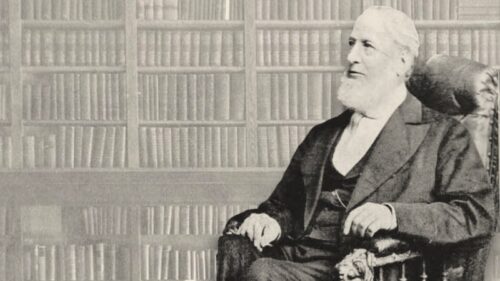
From an age-faded photograph we reproduce in our pages a likeness of the aforetime well-known and affectionately loved blind Clergyman, the Rev. J. W. GOWRING, B.A. The copy which appears as our frontispiece we have for many years treasured in our album as a present from our much-loved brother and former hearer of the Word, Mr. Henry Parker, of London. MR. GOWRING was a Wrangler of Cambridge, a devoted servant of CHRIST, and a loving preacher of the Word of salvation, displaying as an expositor remarkable gifts of perspicacity in his treatment of the holy Word. His early ministry was in association with the late Rev. Richard Hale, in the north, when his powers of vision became seriously affected.
THE LORD then led his steps to the Metropolis, and he for many years efficiently filled the appointments of Sunday Lecturer in the Churches of St. John’s, Horsleydown, and Cripplegate, City. He was never beneficed.
He was a truly holy man, remarkably humble in character, and greatly gifted and edifying in his powers of speech on Scriptural subjects. He was a great friend of our beloved predecessor—Dr. Doudney—and we have extracted from the writings of the latter some interesting proofs of his fraternal relations to him. It was about the autumn of the year 1861 that MR. GOWRlNG was elected Sunday Lecturer at the Church in Bermondsey; and in September, 1865, he was appointed to the historic post of Sunday Evening Lecturer in St. Giles’s, Cripplegate. He kindly acted as President of our “Private Conference on the Deep Things of God” which we established at Holloway when Vicar of St. David’s.
In the GOSPEL MAGAZINE for November 1, 1864, Dr. Doudney wrote:—
“The receipt of a letter from our dear friend and brother in Christ, the Rev. J. W. GOWRING, has given us considerable pain and regret on his account; yet, at the same time, we have the fullest confidence that the matter of which we are about to speak is of the Lord, and that the Lord will not only stand by, but, in some marked, gracious, blessed way, appear for His servant. Our quotation from the letter in question will apprise our readers of the position in which our dear brother is at present placed.
“It has long been to us a source of both surprise and regret that one who has been labouring so assiduously in the ministry of the Church of England for little less than thirty years should still be only a Curate; that his stipend has never exceeded £100 per annum; and this not as a matter of certainty, but dependent, in great measure, upon the free-will offerings of the people.
“True it is that Mr. GOWRING has long laboured under the loss of his natural sight; but this he lost in his Master’s service. His eyesight began to be dimmed whilst yet a diligent and persevering student at Cambridge, seeking there to qualify himself for the examinations which were to precede his taking his degree, and being ordained as a clergyman of the Church of England. Finally, his sight failed him when Curate to the Rev. Richard Hale, the respected and beloved Vicar of Harewood. Upon leaving Harewood, he came to London; and there, as our extract will presently show, he has ever since laboured with an ardour, a perseverance, a self-denial, that exceeds everything we ever witnessed. Mr. GOWRING is no loiterer, but really and truly a labourer in his Master’s vineyard. Although, as we have said, deprived of sight, no one, from his appearance, would be aware of it: his large, dark, full eye betrays no lack of vision; and such is the facility with which he reads the embossed characters, that he conducts the entire service of the Church with the most perfect ease; yea, even to the administration of the Lord’s Supper. To those who have never witnessed Mr. GOWRING’S conducting the service, a sight of deep interest is in reserve.
“That God’s hand was singularly apparent in depriving Mr. GOWRING of sight, is evident from the fact, that, soon after his appointment to a curacy or sole charge in London, he was requested by the committee to superintend the printing of the Bible for the blind. He had both to prepare the copy and revise the proofs; this was a work of immense importance, as well as of considerable labour. We leave our readers to their own conclusions as to what would have been the effect had the sacred text been tampered with, or in the least degree departed from. It wanted a man of Mr. GOWRING’S known character for soundness of doctrine and steadfastness of principle, to superintend such a work. Again, under God, to Mr. GOWRING was due the proposing and the carrying into execution of the printing of the Prayer·book, in embossed characters, for the blind. We leave our readers to judge of the importance of this movement, and of the great boon thus conferred upon those who may be called to suffer the want of sight.
“But, in addition to this singular facility for public reading, God has been pleased to endow Mr. GOWRING with an equally singular retentive memory; insomuch that, when preaching, he will quote Scripture with the utmost readiness and accuracy. What can be more important than this, in these either Bible-disputing or Bible-despising days? We have often thought, in regard to our dear brother, that there seems to be scarcely a single portion of the sacred Word which he has not pondered upon and duly considered. In quoting a passage you never seem to take him by surprise. He is acquainted with the context, and has his thoughts upon the subject in readiness.
“We have said he is a labourer, and not a loiterer, in the vineyard. Witness his upwards of twenty-one years’ work in Kennington. In addition to his regular full Sunday and Wednesday evening services there, he would take one service at an asylum and another service at a police-station, besides a diligent visitation of the sick and the troubled. No man is more ready to sympathize with the sorrowing than Mr. GOWRING.
“For the last three years or thereabouts, in addition to his two full Sunday services at Kennington, he has read prayers and lectured every Sunday afternoon at St. John’s Church, Horsleydown. Thus, from his leaving his home soon after ten o’clock of a Sunday morning, he has never returned, but been almost uninterruptedly engaged, until nine o’clock at night. And all this the work of a blind clergyman—ever ready and always happy in his Master’s service.
“We know this is saying much, but it is not saying too much. We write altogether without our brother’s knowledge; and we feel that we cannot, in common honesty, say less than we have said.
“As a man, Mr. GOWRING is one of the most cheerful and animated. As it has been often said, if God sees fit to deprive of one gift, He graciously bestows another; so is it in this case. Mr. GOWRING is among the most agreeable of companions, and never so happy as when conversing upon the best of all themes. We know of no man more diligent, nor of any better calculated for a course of pastoral visitation.
“Before we quote from his letter, we will just add, that nothing would afford us greater pleasure or satisfaction than the hearing of his appointment to some definite sphere of labour in the Lord’s vineyard. Sure we are that, if so appointed, he will be found a devoted, self-denying servant of his Lord and Master.
“6, Somerset Place, Stockwell, S.,
“Oct. 10th, 1864.
“’MY DEAR FRIEND,—Since you were here my dear wife has been very ill, and previously to that I was myself very far from well, and in fact was laid by the last Sunday in June; but this was the only Sunday for nearly twenty years that I have been prevented by illness from occupying my usual post. I should have written to you last week, but we were at Brighton, and the change of air, through the Lord’s mercy, has certainly been beneficial to my dear wife’s health. She had been five Sundays away from Kennington, but yesterday week resumed her place there; but it proved necessarily a very trying time to her, as I had to give notice that my continuance there must cease after next Christmas Day. Last Friday week I received notice from the new Incumbent of Kennington, that, in consequence of proposed alterations in the services of his parish, he would require the Schoolroom in Bolton Street. The following was my answer to his letter:—
“REVEREND SIR,—It is now more than twenty-one years since I commenced my labours in the Gospel at Kennington, and this year completes my seventeenth year in the Schoolroom at Bolton Street. I cannot therefore but feel somewhat deeply the prospect of a separation from a place where the Lord has blessed the ministry He has committed to my trust. However, I must necessarily abide by your decision, and therefore conclude from your letter received last night, that Christmas Day which is the last Sunday of the year, will be the last day that I shall be permitted to preach Christ’s Gospel to the flock to whom I have ministered at Bolton Street Schoolroom.”
“‘Within a few minutes after I received the letter, there was brought to my mind these words from Exodus 14:13, “Stand still, and see the salvation of the Lord; speak to the people that they go forward.” I could not but receive them as a message from the Lord for present comfort and guidance, and through the Lord’s mercy I have thus far been kept quiet, without any intimation whither or where I am to go forward; and I desire to be kept without having a choice in the matter. My text yesterday week in the morning was Romans 1:16-18; and in the evening I took the above words from Exodus 14. As I know that you have always taken an interest and watched from the beginning the progress of the work to which the Lord separated me at Kennington, I have taken the earliest opportunity to let you know. I need not ask you to remember me at the throne of grace, when it is well with you; as I know that I am not forgotten by you. With our united Christian love to you and yours, I remain,
“Your faithful friend and brother in the Lord Jesus,
J. W. GOWRING
John Gowring (?-1880) was a High-Calvinist Anglican preacher. He came out as eleventh wrangler at Cambridge; appointed afternoon lecturer at St. John's, Bermondsey; as evening lecturer at St. Giles's, Cripplegate; for twenty years one of the curates at Kennington. Having lost his sight, he became known as the “blind preacher” and was appointed the monumental work of prepare and revise the proof-sheets of the Bible for the blind, along with the Prayer-book.