Upon This Rock
[Posted by permission. Bethel Strict Baptist Chapel.]
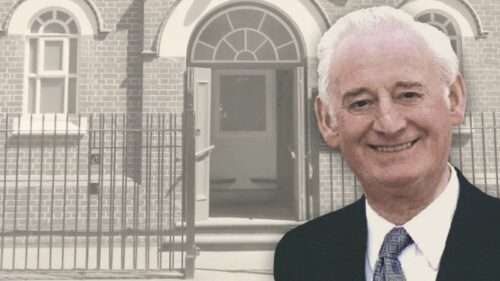
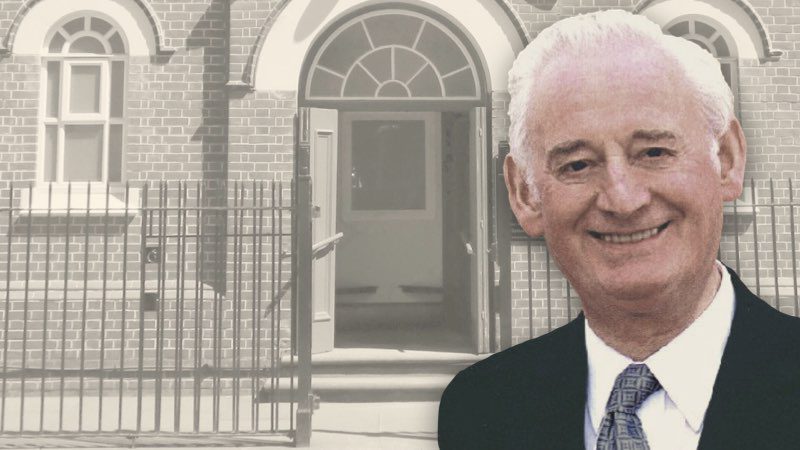
Sermon preached at Bethel Chapel, Luton, by Mr. B. A. Ramsbottom, on Lord’s day evening, 1st August, 2021
“Upon this Rock I will build My church; and the gates of hell shall not prevail against it”—Matthew 16:18
Our Lord and Saviour Jesus Christ was about to remind His beloved disciples that He was going to be crucified, put to death by the hands of wicked men. A verse or two after this, we read, “From that time forth began Jesus to shew unto His disciples, how that He must go unto Jerusalem, and suffer many things of the elders and chief priests and scribes, and be killed, and be raised again the third day.”
Now it was the Saviour’s desire that before His death came, His people should be well grounded in the truth of who He is, the eternal Son of God. So on this occasion they were in that beautiful spot, Caesarea Philippi – not the Caesarea on the Mediterranean coast that we read about a few times in the Acts of the Apostles, but a different Caesarea, further inland, Caesarea Philippi. The Lord Jesus asked His immediate disciples a very interesting question. Let us be clear: He knew the answer, but He wanted lovingly to draw them out. This was the question: “Whom do men say that I the Son of man am?” And they began to give all kinds of various answers. Let us be abundantly, clear, beloved friends – they were giving the nicest answers, the kindest answers they could. “They said, Some say that Thou art John the Baptist: some, Elias; and others, Jeremias.” Then some of them said, “One of the prophets.”
And then the Lord put that vital, pointed question to them, and really it is the vital, pointed question to you and me, not only this evening, but at all times: Ye. That is what matters in real religion – not other people – ye. “He saith unto them, But whom say ye that I am?” And Peter, lovingly, graciously, speaking on behalf of the rest: “Thou art the Christ, the Son of the living God.” That is the vital point in real religion, not just to be able to say it, but to know it savingly and believingly, to know Him, the Son of God, whom to know is eternal life.
I rather think I am right in saying this, that J.K. Popham, before he took someone down into the water at Brighton to baptize them, personally used to put that question to them: Do you believe that Jesus is the Son of God? And he expected that simple, right answer by faith. “Thou art the Christ, the Son of the living God.”
It is very clear from what follows that those who are led by the Spirit to speak language like this, and to know truths like this, are blessed people. Jesus said, “Blessed art thou, Simon Barjona.” He reminded him of his old name, his original name, his name as a sinner. O but what grace had done for him! What a difference it had made! “Blessed art thou, Simon Barjona.” And then He reminded Peter, and also to the end of time reminded us, there is only one way really that this God can be savingly known. “Flesh and blood hath not revealed it unto thee, but My Father which is in heaven.” It is important to have a religion of divine revelation. Do not be confused on that. Some people tend to think revelation is something like having dreams or visions or mystical things. It is the Lord Himself showing us, teaching us some vital thing that we did not know before, we did not know by nature. “Flesh and blood hath not revealed it unto thee, but My Father which is in heaven.”
And then follows that statement which has been so much misunderstood. Of course, the Roman Catholic church has always believed, and still believes today, that Peter is the rock foundation on which the church is built. Now our Lord Jesus never meant that at all. We do not want a foundation who could deny his Lord and Master with oaths and curses. We do not want a foundation that only a few verses after this, the Lord Jesus called Satan. A surprising word: “He turned, and said unto Peter, Get thee behind Me, Satan: thou art an offence unto Me.” We do not want a shaky foundation, a sinful, fallible foundation, a foundation that can give way.
What did the Lord Jesus mean? Peter, a stone, a stone in this living building, the church of God. “Thou art Peter,” favoured Peter, blessed Peter, an eminent stone in this building; but Peter, it is “upon this Rock” – a different rock from thee, Peter, the Rock Christ Jesus. There is only one foundation on which the church of God is built. “Other foundation can no man lay than that is laid, which is Jesus Christ.” “Upon this Rock I will build My church; and the gates of hell shall not prevail against it.” So it is a very beautiful subject, it is a precious subject, and it is a subject which is vital.
Now having said these few things by way of introduction, very simply this evening I would like to speak to you about this Rock, the Rock Christ Jesus, and then His beloved church, “My church,” and then the building of the church, and finally, the church’s everlasting safety and security. “The gates of hell shall not prevail against it.”
So here we have that well-known subject, and a beautiful subject it is: Christ the Rock of Ages. You children must know that the Lord Jesus sometimes compares Himself to a Shepherd, and sometimes He compares Himself to the true Vine, and we could go on. We could no doubt think of so many things this evening that the Lord Jesus compares Himself to. But I think you will find that more than anything else in holy Scripture, He is compared to the Rock, the simple point being,
“Is He a Rock? how firm He proves!
The Rock of Ages never moves.”
The glory of Christ, “Jesus Christ the same yesterday, and to day, and for ever,” the immovable Rock of Ages.
Now you have so much about the Rock in the Old Testament, especially David in the Psalms. He is constantly speaking of the Rock. “The Lord liveth; and blessed be my Rock; and let the God of my salvation be exalted.” Just how much David knew of the Lord Jesus, we are not sure. One thing we do know: he was graciously taught a lot; he knew a lot by the teaching of the Holy Spirit. To David, the special point seemed to be, my Rock – He was always there. He could be depended on. He would never fail. He was always there.
And then in other parts we have so much about the Rock of Ages. You can think of such different ways. Sometimes it is a cleft in the rock where the unworthy sinner can find a hiding place from the wrath of a holy God. There is the well-known hymn,
“Rock of Ages, cleft for me,
Let me hide myself in Thee.”
We also have “the shadow of a great rock in a weary land,” sheltering from the burning heat of the midday sun. We read of Moses being covered in the hollow of the Lord’s hand. Then we have quite a different figure, thinking of the rock in Horeb that Moses struck, the source of those streams of living water, all the blessings of the gospel of the grace of God. And then the Apostle Paul takes it up: “They drank of that spiritual Rock that followed them: and that Rock was Christ.”
But the point here, of course, is the Rock of Ages as the foundation, the only foundation on which the church is built. The whole church of God needs a good foundation, and you and I need a good foundation for our religion.
I think I have often told you – you must excuse repetition – that when I first came to Bethel, there was a beautiful old church building at the top of King Street, and it was going to be demolished, and people were asking why. It was such a lovely building. Well, they said, everything was good about the building apart from one thing: the foundation was not safe, and so the whole building was having to be taken down. That was quite a word to us at Bethel in those days.
We must never forget the well-known parable of the Lord Jesus – the two men. One was building his house on the sand. He had got a sandy foundation, and his house seemed alright until the wind blew, and the storm came, and that house “fell: and great was the fall of it.” Now there was another man, and he built his house on the rock, and it is not only that which we are told. We are told one or two interesting things. He “digged deep.” I am not trying to think of having a deep religion, or to be deeply led, or deeply taught, but this wise man kept digging deep. He was not satisfied till he struck a rock, and he kept on digging until he found the rock, and then he built his house. Probably the other had finished long before, and he was happy with it until the trying time came.
It comes to the righteous and the wicked. Whatever we profess, unless through grace, by faith, we build our hope for eternity on Christ the Rock of Ages, on who He is, on what He has done, unless we build there, then our house shall fall. These days, beloved friends, I often look back and think of my early days at Bethel, and I was thinking of the first church member’s funeral I ever took. She was a lady probably most of you have never heard of, but I remember when she died preaching on this: “It fell not: for it was founded upon a rock.”
“Upon this Rock I will build My church.” If we read of the wise man in the parables, what about the dear Lord Jesus as the wise Man, and He built His house on the rock. We think of one or two of those beautiful words in Isaiah and quoted in the New Testament by Peter, this same Peter. If you come to Peter’s Epistle, he keeps reminding us of the Rock, and he tells us one thing about it: it is precious. “Unto you therefore which believe He is precious.” This is the word: “Behold, I lay in Zion for a foundation, a stone” – this is the Rock of Ages – “a stone, a tried stone, a precious corner stone, a sure foundation: he that believeth shall not make haste.” Another place says, “He shall not be confounded.”
“Upon this Rock I will build My church.” This Rock is Christ alone, but it is not discarding Peter’s wonderful profession: “Thou art the Christ, the Son of the living God.” “This Rock.” “Upon this Rock I will build My church.” So personally, you and I by nature are building on all kinds of things for eternity. We all know we have to die one day. We all know we are not ready. We are all building on something. Some are building on thinking there is no eternity. Some are building, thinking there is no God. Some are building, they think everybody is going to be saved. Many are taking things for granted. Others think there is plenty of time. Everybody is building for eternity, and you and I by nature build on a wrong foundation, and the Lord will sweep it away. I remember in my early days it was this:
“Every prop, from first to last,
Sure must sink, but Jesus Christ;
He’s the sure foundation stone;
Build on Him, and Him alone.”
So we see our need of a Saviour, and we see our need of Him as the Rock. We need Him to forgive us. We need Him to wash us in His blood. We need Him to make us right for heaven. It is this:
“On the Rock of Ages founded,
Nought can shake our sure repose.”
It is not just a belief on the example of Christ, not just on His beautiful teaching. It is on His Person and His work, His suffering, His death, His precious blood that cleanses from all sin, the atonement He made, His glorious resurrection and ascension, almighty to save. “This Rock,” the Rock Christ Jesus.
“Upon this Rock I will build My church.” Now if you were to go out into the streets of Luton tonight on your way home and ask people what a church is, I am sure they would probably speak of the parish church in the town centre, or even this Roman Catholic church close at hand. They would speak of a building. Now in the Word of God, the church is never a building. Other people might give you, shall we say, a more sophisticated answer. They might say, Well, there is the Church of England, there is the church of Rome, there is the Methodist church, there is the Baptist church.
Now in the New Testament, the church is never any kind of human organisation, however good. Now what is the church? I understand the word in the original means, the called out ones, those the Lord calls. So really the church of God – all the Lord’s people in all ages, every one of them, from beginning to end – some not yet born – the Lord’s chosen, the Lord’s redeemed, the Lord’s sanctified. What a lovely word that is: “Christ also loved the church, and gave Himself for it; that He might sanctify and cleanse it with the washing of water by the word, that He might present it to Himself a glorious church, not having spot, or wrinkle, or any such thing.” Have you noticed how affectionately the Lord Jesus calls it My church? They are all sinners, every one of them, but they are all loved with an everlasting love, and the Lord Jesus calls them My church.
Just in passing, there is one other way in which the New Testament does speak of the church – not just the body of all God’s people in all ages, but each individual church in a certain place, like we read of the church at Rome, the church at Philippi, the church at Colosse – each church composed not just of those who profess the Lord’s name, no; but each local church made up of those who are true believers on the Son of God.
“Upon this Rock I will build My church.” They belong to Christ, the whole church, and of every single sinner here this evening who has truly been blessed with faith in the Lord Jesus, He says, “My church.” “Fear not: for I have redeemed thee, I have called thee by thy name” – this is it – “thou art Mine.” “My church.” Mine by eternal choice; Mine loved with an everlasting love; Mine by redemption; Mine, the purchase of My precious blood; Mine by calling. And then, what does the Lord say? “They shall be Mine … in that day when I make up My jewels.” Well might our hymn- writer pray that prayer:
“Gracious Saviour,
Own me in that day for Thine.”
“Upon this Rock I will build My church.” And then just a word or two about the building of the church, because we have the church compared, like its Maker, various comparisons, but here and in many other places the true church of God is compared to a building. It is all of Christ.
Many years ago when I was a young teacher, even before I went to university, I taught at a kind of private school in the heart of Cheshire, and one of my duties occasionally was to take the boarders there on the Sunday morning to the local church. One Sunday, the vicar there had a text something like this. The boiler had failed, and it was the middle of winter. The place was freezing cold. So he said, “I am not going to keep you long. I will just give you my headings.” If I can remember them, he said, “The church – the building of Christ. Christ the Architect – He planned it; Christ the Builder – He built it; Christ the Buyer – He bought it; Christ the Owner – He owns it; Christ the Occupier – He lives there.” And he had a few more things. I have never forgotten them since that day, though it was so long ago.
But the Lord Jesus said, “I will build My church.” It is not some famous preacher who is going to do it. It is not some wise evangelist going to do it. “I will build My church.” And we want to be among them whom the Lord Himself builds, because He builds them all on the Rock of Ages.
Now where are they by nature? There is a quarry, the quarry of nature, “the children of wrath, even as others,” sinners deserving a lost eternity, and the first thing is the hewing out of the rock. They have to be separated from that rock wherein they were found by nature. Sometimes it is hard work, that hewing out. In the little town where I lived up in the Lancashire hills, we were at school and sometimes, perhaps a few times a year, you would hear a terrible noise going on like an explosion, and they said up in the quarries they were blasting, and they needed dynamite to get the pieces of rock loose. Whatever the Lord uses, He will loosen you from the world, and loosen you from your false profession, and loosen you from what you once were. That is the first thing the Lord will do to build a stone in the building.
Well, the second thing is for the stone to be fitted and shaped and fashioned by the Holy Spirit. “This people have I formed for Myself.” They are being fitted and shaped and fashioned. There is something to be smoothed off there, something to be broken off there. But what really is that preparation? It is bringing that sinner to know that he cannot do, he cannot manage, he can never be saved, without Christ. Now that is it. “Am I ready to meet God?” O to seek to be “made a real Christian, washed in the Redeemer’s blood.”
And then the third thing is, when the stone is shaped and formed and fashioned, it is not just left where it was. It is brought to the place where the building is going up, and it has to be fitted in the building. But first of all, it has to be drawn. There must be that drawing to Christ, that attraction in Christ, and if you do not really feel it, you young ones, and you long to feel it, that is a good prayer: “Draw me, we will run after Thee.”
“Jesus draws” – attracts – “the chosen race By His sweet resistless grace.”
And the final thing: the stone has to be laid in its place. There have been so many stones laid in their place. Abel was the first one, and how many since, and how many still to be laid in their place! But this building is higher this evening than it has ever been since Adam fell. Never forget that. The world will only exist until the last stone, hewn out, fitted, formed, fashioned, drawn, is put in its place, and then the angel will cry, “Let time be no longer,” and you and I will either be right or we will be eternally wrong. It is the great point. You know where every one of these who are part of the spiritual building are brought:
“My hope is built on nothing less
Than Jesus’ blood and righteousness;
I dare not trust the sweetest frame,
But wholly lean on Jesus’ name.”
If you are there by grace, then you are safe, and safe to all eternity, despite all your faults, your failures, your blemishes, your sins. Why? Because your salvation is not in you; it does not depend on you. It depends on that glorious Rock of Ages.
“Upon this Rock I will build My church, and the gates of hell shall not prevail against it.” So hurrying to our close, “the gates of hell” – that means the strong places of hell, all the strength of sin and Satan and the world and unbelief and the whole lot are opposed to this building, opposed to this glorious Builder, and they would knock this building down if they could. They have been striving since Adam fell, and they are striving today. You girls and boys at school, and then when you go to college, you will come against these gates of hell, and they are fighting, and they are striving, and not just against this building, but against you and against what you believe, but here is the promise, a blessed promise, a promise to plead, a promise to rest on, a promise to live upon, to die upon.
“Gates of hell shall never ’
Gainst His church prevail;
We have Christ’s own promise,
And that cannot fail.”
“Upon this Rock I will build My church, and the gates of hell shall not prevail against it.”
Behold the sure foundation stone
Which God in Zion lays,
To build our heavenly hopes upon,
And His eternal praise.
Chosen of God, to sinners dear,
And saints adore the name;
They trust their whole salvation here,
Nor shall they suffer shame.
The foolish builders, scribe and priest,
Reject it with disdain;
Yet on this Rock the church shall rest,
And envy rage in vain.
What though the gates of hell withstood?
Yet must this building rise;
’Tis Thy own work almighty God,
And wondrous in our eyes.
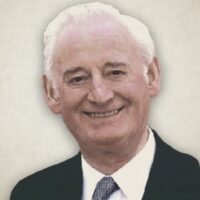
Benjamin Ramsbottom (1929-2023) was a Strict and Particular Baptist preacher. In 1967, he was appointed pastor of the church meeting at Bethel Strict Baptist Church, Luton, Bedfordshire, a position he held for fifty-five years.