
The Value Of The Divine Scriptures
“Most wondrous book! bright candle of the Lord!
Star of eternity! the only star
By which the bark of man can navigate
The sea of life, and gain the coast of bliss
Securely.”—“The Course of Time,” Robert Pollok.
In studying the Word of God, we do not come to sit in judgment upon the Book, but to hear reverently and believingly what God, the Author of the Book, has to say unto us. In the language of youthful Samuel we say, “Speak, Lord, for Thy servant heareth.” If we would gain profit by the study of God’s Word, we must ourselves be taught of the Holy Spirit. Our intellect, our heart, our conscience must be entirely submissive to His teaching. Then when we are willing scholars surrendering ourselves to Him, He will teach us all things, and bring all things to our remembrance which our Lord hath spoken to us.
1.—THE VALUE OF THE SCRIPTURES is based on “their Authority,” though in their production they cover a period of many years, and were written by a number of men. We are assured they were all divinely inspired by the Holy Ghost, “For the prophecy came not in old time by the will of man; but holy men of God spake as they were moved by the Holy Ghost.” He inbreathed into them the thoughts and the words they were to write. There is a “Thus saith the Lord” stamped on every page of this Divine Book; David, the sweet psalmist of Israel, wrote: The Spirit of the Lord spake by me, and His Word was in my tongue (2 Sam. 23:2). Our Lord, in His ministry, constantly quoted from the Scriptures as His authority in teaching, and although there was His Divine right seen in His speaking, ”I say unto you,” He led His hearers to the Word. If His teaching seemed contrary to the Word, it was not so, He was only explaining its deeper spiritual meaning which underlies the letter of the Word.
“Think not that I am come to destroy the law, or the prophets, I am not come to destroy but to fulfil: for verily I say unto you, till heaven and earth pass, one jot or one tittle shall in no wise pass from the law till all be fulfilled.” Let us then with unwavering faith accept every word of God without questioning; although translated into our mother tongue, we have a very accurate rendering of the original.
2.—THEIR EFFICIENCY. There is a power in God’s Word possessed by no other book. It penetrates the deepest recesses of the heart. It convinces the conscience. It subdues the wayward will. It illuminates the darkened understanding; it produces such a change in a person that it makes the careless thoughtful, the sinful repentant, the godless prayerfully suing for mercy at the footstool of God’s throne; it brings down pride, “The sword of the Spirit which is the Word of God,” slays righteous self. It makes the sinner ashamed of himself and loathe his sins. It opens his heart and makes a way for the reception of the Gospel of sovereign mercy and love. The Word opens his eyes to see a beauty and desirability in Christ. It leads him to the Cross and lifts his burden of sin and woe. Turns his sorrow into joy; wipes away his tears and speaks words of peace to his troubled heart. Assures him of his interest in the spotless victim who died for him on the tree; the Word fills him with hope and assurance of eternal glory. It has made him a new creature; it upholds him in the life he now lives, for he lives upon the Word of God. It strengthens in temptation, it supports him in trial, it is his weapon in conflict with every evil— the smooth brook from whence he takes the stone to smite giant sins and lay them prostrate at his feet.
3.—THEIR VARIETY. They contain history the most ancient from the creation; yea, thy inform us of God’s eternal love and plan of redemption ere the world had its birth. They predict future events until the Angel of God shall stand on sea and land, and declare that time shall be no longer. They tell of the most marvelous events this world has ever seen, and they record the most minute transactions which would pass unnoticed only by an omniscient gracious God.
They give instruction for every path of life, and advise us for each step we may take. No emergency can arise, however perplexing, but we shall find guidance given us in these sacred oracles how to act. Are we bowed down with sorrow? Here are found the choicest words of comfort in all literature to cheer our burdened spirits. They visit the home of bereavement and the open grave, and yield their sweet solace there. The poor and needy are not overlooked in their struggle; but heart-cheering promises are given to them. The lover of the beautiful may range through these sweet fields and pluck its fragrant flowers; may climb its lofty mountains and there gaze out beyond the confines of this lowland earth. Is the heart glad and filled with ecstatic JOY, and would it find a song of praise worthy to sing to the Most High God? Here, in this sacred Book, is found the grandest poetry ever penned. Does the human soul long to speak in prayer and fail to find the fitting language? Here are prayers, sublime in their utterance, pathetic in their pleading, humbling in their confessions of sin and weakness, earnest in their entreaty for help and pardoning grace. Would we speak to our fellow men on the important theme of their soul’s salvation, and are we slow of speech and lacking in words to clothe our thought. Here shall we find the most impressive oratory that ever fell from human lips to teach us how to address men concerning sin and salvation, in language, solemn, faithful, earnest and instructive to their souls. When we reach the end of life’s journey, and the shadows of evening are lengthening and earth’s light grows dim upon our path, this sacred volume will prove a lamp of undimmed brilliancy to light us through the dark valley to worlds beyond. From infancy to manhood and down to old age, it is adapted to every stage of our journey, and has a message suited to every need.
IV.—The preciousness of the holy Oracles of truth appears yet further when we consider THEIR SUFFICIENCY. They are sufficient in their matter to instruct our mind. If we had no other book and were well acquainted with this, we should be no mean scholars. “They are able to make wise unto salvation.” No other book will do this. In vain we ask science and philosophy, How shall man be just with God? This book alone solves the important problem, and it does so most satisfactorily. The highest intellect here finds a plan beyond human reason of the highest order—sublime, for it is God’s conception, worthy of Himself; and, like all His glorious works, it is so perfect it needs no embellishment from puny man.
It is sufficient to answer all the cavils of unbelief.
“This is the Judge which ends the strife
Where wit and wisdom fail.”
It is sufficient as a basis for our faith to rest upon secure. We can live and die upon its sacred truths. Its doctrines are a solid foundation. Its promises are the pillars. The oath and covenant of God are the bulwarks of our faith; we need no other. The person, merit, and atonement of Christ which it reveals is sufficient for all our salvation and our hope. It is sufficient at all times. Whatever advances are made in learning, the Bible does not become obsolete. It is always before the times, for it carries us on into eternity. It is sufficient for all man’s deepest needs, sinful and fallen as he is. There is everything in it to lift him up and place him higher than angels are. It stills the throbbings of a longing heart hungering for God; it eases the guilty conscience and gives true peace; its truths rested upon, fill and satisfy the believing soul, so that no more is needed but heaven itself at last to consummate the bliss.
V.—THEIR VERACITY.—The Word of God cloaks nothing, or conceals it in any way. The glaring faults of its characters are as faithfully set forth as their virtue. Abraham’s prevarication about his wife and his sin with Hagar, as well as his noble faith and implicit obedience to God’s command regarding the offering up of his son Isaac are recorded; David’s lust, adultery, and murder are written down without any extenuation of his grave faults; Peter’s blasphemy and base denial of his Lord, as well as his brave confession of faith. We have a faithful picture of fallen man and the dreadful outflow of all the sin of his wicked heart in rebellion against a holy God, side by side with the manifestation of the fathomless depths of God’s mercy and love to sinners; we have the spotless character of Christ, who was purity, love and truth embodied in human form, and we have man’s inveterate hatred of the Son of God. The picture is sad and humbling that man should be guilty of such foul crimes which are recorded in the Bible, but they, nevertheless, are absolute facts which cannot be gainsaid. Fiction may paint her heroes with all the noblest virtues and hide all the deficiencies and vices. The Bible never does that. It would not be a true book if it did. Its faithful impartiality stamps it with undeniable veracity through all the ages in every detail which it records.
VI.—THEIR SIMPLICITY.—The Bible contains the loftiest thoughts couched in the most sublime language of all literature, but it is still a book written for the “common people.” It visits the Court and tells of the doings and sayings of kings, but it moves in rural scenes. It speaks to the ploughman as he tills the soil, and the shepherd on the hillside as he feeds and guards his flock, in language which they can readily understand. It has a message for the fisherman toiling amid daily peril on the deep. He feels that the God who gave the Bible knew just his danger and his need. The mother, with her home duties so exacting and wearying, often finds comfort and help in the grand old Book—the very word she needs. The child, young and inexperienced, will find here sacred lessons just suited to their age and capacity; but best of all is its simplicity in the matter of the soul’s salvation. Here we find no involved theories, but heaven’s simple plan; “Believe on the Lord Jesus Christ and thou shalt be saved.” It points out clearly the path to heaven for simple souls; he who makes this Book his guide shall not err. It speaks to the heart rather than the intellect, and its language is understood by all those who love God, whether they are versed in human learning or not. They are taught of God, and know the meaning of His Word, for it answers as an echo to their inner experience, or rather their experience answers to the Word.
VII.—THEIR CERTAINTY.—The Bible is not written in dubious language. Its writers spoke because they knew; there is no hesitancy in the Bible statement; no apologies are made, no requests to accept its statements if they are proved to be true. We are requested to “Search the Scriptures,” but it is to prove that we are wrong if our opinions are not in harmony with God’s Word. The Bible speaks with absolute inerrancy. The slight errors (if there are any) in its translation do not alter its certainty. We have the Word of God. We have not followed cunningly devised fables. The Bible has stood the test of all the critics, and will stand when hostile works against the Bible have all perished and been forgotten. The Bible will still remain an impregnable fortress when all the shafts of man’s unbelief have fallen blunted and broken at its base. It will still continue to speak in solemn certain tones to the sons of men—of God, of sin, of salvation, of heaven, and of hell. It will remain, as long as the world doth stand, a certain trustworthy guide to all heaven-bound pilgrims in every age. They will never miss their way to that celestial city who follow its teachings. Those who live by the truths of this Book will be calm and secure in every storm; their lives will be fragrant with holy deeds; no one will have cause to doubt “Whose they are and whom they serve,” and when their journey is completed and the cold water of death are surging around them, they will have no cause to fear. An abundant entrance into the haven of eternal peace shall be most assuredly ministered unto them in that hour. They who commit themselves to the sure teaching of this Book will have certainty in life, calm support in death, an eternal abode for ever and for ever in bliss.

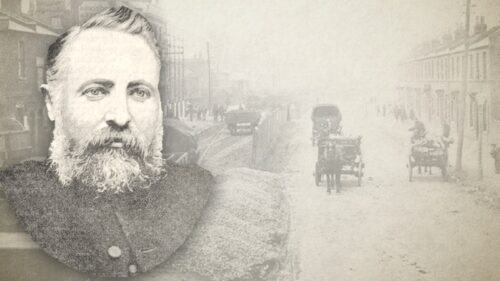
Edwin White (1846-?) was a Strict and Particular Baptist preacher. His first pastorate was with the church meeting at Orphington (1877-1879). After two years, the communion question cropped up, the majority of members deciding to throw the Table open. He forthwith resigned his office. His second pastorate was with the church meeting at Clare, Suffolk (1881-1887). After six years of blessed ministry, he resigned the office due to health reasons. His third pastorate was with the church meeting at Woolwich, Enon Chapel (1891-1919). In 1911 was elected president of the Metropolitan Association of Strict Baptist Churches.