“Hitherto”
“Hitherto hath the Lord helped us.”—1 Samuel 7:12
The review of the past fills the heart with gratitude: every waymark has a voice to awaken praise to Him who has brought us thus far on life’s journey: it enkindles hope for the future. These stones of help which we have reared, are stepping-stones to higher and nobler efforts than have as yet been achieved. These are the lessons we would gather. Let us note in this instance,
DIFFICULTIES OVERCOME.
If there were no conflicts there would be no monuments of victory reared. It is, where we have fought and won the battle, we set up a token of our thanksgiving to our God; as one dear old saint said to the writer, “If the children of Israel had not had some rough stones to walk over, they would not have found any to set up their Ebenezer with.” Difficulties stimulate courage; they prove the genuineness of our faith, and they give us a retrospective experience which is very valuable; we look upon these stones of help, and it nerves our arm to fresh conflicts; we gird on our armour with renewed courage, and present a dauntless front to the foe. Every weary pilgrim on heaven’s way coming to one of these waymarks breasts the hill before him with better heart; where other footsteps have trod he will endeavour to plant his feet, until he reaches the summit, and stands upon the “Mount of God, with sunlight in his soul.” “Hitherto” is not written in anyone’s history without tears, conflict, and much hard toil. Every step forward has been hardly won with many a prayer, and ofttimes a weary heart.
DEPENDENCE ACKNOWLEDGED.
The servant of God who has the most marvellous history, takes no praise to himself. It is the Lord’s doing, and it is to Him the glory is due. He who labours more abundantly than they all, writes at the end of his lifework, “Yet not I, but the grace of God which was with me.” The Lord is pleased to unite His almighty aid to our poor efforts, and thus it is it comes to pass that there are stones of help reared; but it is His name which is inscribed upon them all; His tender gracious nearness has been the source of strength; His unfailing help has supported, or no “Hitherto” would have been written. Instead of a fair column, erect and whole, studding the path we have trod here and there, there would have been broken pedestals and ruined monuments, lying in fragments all along the way to mark our defeat and disaster. But it is not so; we gladly, gratefully own how much we owe to Divine help in all we have passed through, every temptation overcome, every good deed wrought, every triumph achieved in the cause of right and truth, every upward ascent in the path to glory, “‘Tis He who hath helped.” We have been but working out what He has wrought within. All glory be to His name. Our feet have stood firm in the evil day, “but we have been kept by the power of God unto salvation.”
DELIGHTFUL RETROSPECT.
“Hitherto!” What many tender memories that word awakens as we review the past! How much we have been helped in providence. Jacob is not the only one who could say, “With my staff I passed over this Jordan, and now I am become two bands.” Reflect upon the early struggles, the straitened means, the anxious care, the constant fear lest you would not be able to “provide things honest in the sight of men,” and that Holy Name by which you are called would be dishonoured in your failure before the world. But it has not been so; the barrel may have yielded but one handful, but it was never exhausted, and now in many instances He hath stored the barns with plenty, and the presses burst forth with new wine. The table now groans under the weight of increased good, where once it was but scantily furnished. This should awaken grateful reflections of thanksgiving to Him. But there are higher notes than these. The man is more than circumstances. He hath opened His hand bountifully to our daily needs, but He hath given Himself for our souls. He hath begun a good work in our hearts which has been the source of joys unutterable, and hopes only bounded by eternity. The reminiscence of that time, when first we heard in our hearts the voice of pardoning mercy, lingers and echoes in our memory as the notes of sweetest music long drawn out, times of hallowed intercourse with heaven come back and awaken very tender feelings in our breast.
DETERMINATION INCITED.
The past is, after all, a stepping stone in our onward march. We must not stay permanently even round our Ebenezers: we must erect them, and press on. These are rather for those who come after us to see what great things God did for us; while we attempt greater deeds in the name of our God. The faith which bore us onward to one stone of help will be all the stronger for an untried path which lies before us, and the very fact we have all these monuments behind us will nerve our hearts with courage to greater daring in the cause of the Lord. We have seen that we have not reached the present in our own strength. That help which has brought us hitherto, will be with us to the end, and there is ever a reserve of power with our God. We have no limit in the supply. We may draw upon Him. The sea hath bounds, the earth is weighed in the balance by Him, and the heavens are measured; but there is no place where you can erect a statue, and say, “Hitherto God’s help comes to His people, and no further.” Whatever may be in the unknown future, His”hitherto” carries us onward without any limit. Whatever foes we may have to meet, or trials to bear, we feel quite equal to in His strength; His help will not fail at any crucial time, but then we shall prove it all-sufficient. Thus would we lift our standard, and wave it boldly as we march forward. “Hitherto the Lord hath helped us.”
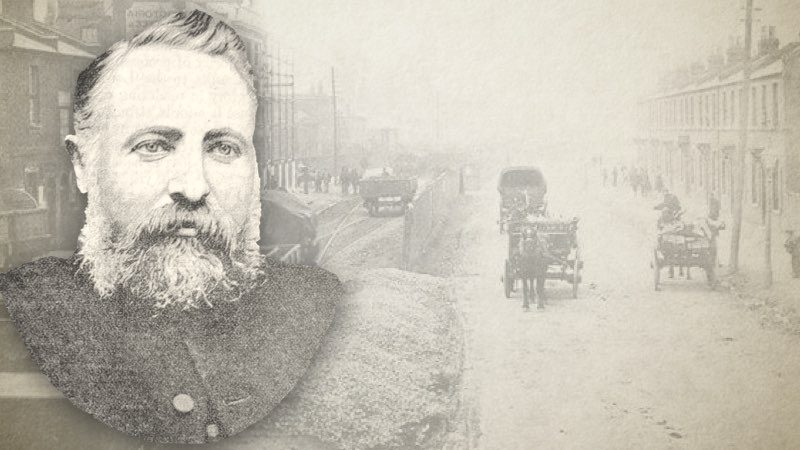
Edwin White (1846-?) was a Strict and Particular Baptist preacher. His first pastorate was with the church meeting at Orphington (1877-1879). After two years, the communion question cropped up, the majority of members deciding to throw the Table open. He forthwith resigned his office. His second pastorate was with the church meeting at Clare, Suffolk (1881-1887). After six years of blessed ministry, he resigned the office due to health reasons. His third pastorate was with the church meeting at Woolwich, Enon Chapel (1891-1919). In 1911 was elected president of the Metropolitan Association of Strict Baptist Churches.