Unwavering Faith
“Let us hold fast the profession of our faith without wavering (for He is faithful that promised).”—Hebrews 10:23
Our text implies that there are difficulties before us, or there would not be such language used. There will be things which will try to wrest our faith from us. That faith which God gave us at the first we are to continue in; and though there is a growth in the grace of our Lord Jesus Christ, yet we are to continue in the same faith which God planted in our hearts at the first. Therefore, the apostle says, by the inspiration of the Holy Ghost, “Let us hold fast the profession of our faith without wavering.” The opposite would be to hold two opinions. The prophet Elijah, on Mount Carmel, said to the people, “How long halt ye between two opinions? If the Lord be God, worship Him, if Baal, then worship him;” meaning that sometimes they held one way and sometimes another. Then another thing is to be changeable, holding the doctrines of free grace one day and the contrary the next. A friend told me the other day that when he meets a certain man be always says,
“WHAT ARE YOU NOW, BROTHER?”
At one time he was a Baptist, then a Congregationalist, then a Wesleyan, so he always asks him what he is now? Not to hold fast is to be changeable, like the wind, constantly changing from one point to another; but if God has given us the grace of which the text speaks, I do not think it will be a changeable one.
Then the opposite again, is to be apathetic, and though a person may not give up their profession, they are so cold and lethargic, and hold it with such a loose grasp. It is to be wavering: a figure of speech also used by James, when he says, “He that wavereth is like a wave of the sea driven with the wind and tossed.” And so is one who is changeable in faith, not stable, never firm.
I.—THE POSSESSION. II.—THE EXHORTATION. III.—THE ENCOURAGMENT.
1.—The possession: our faith. You cannot hold a thing if you have not got it; you cannot retain what you do not possess; but the apostle says here, “Let us hold fast the profession of our faith.” Our faith! We may take it in both ways: the object of faith, and the internal act of faith in the soul; resting on one object, the Word of God, the work of Christ, the immutable oath and covenant of Jehovah, and that is sure and certain, immovable and eternal. Then there is subjective faith: that which dwells in the heart of the Christian; and that is what our text speaks of to-night. It is a special faith. We read in the Word of God of different kinds, and the old Puritans were wont to divide faith in different ways. They spoke of historical faith, believing that Christ was a Divine person: that He was truly human: that He came to work out, and die for, men’s salvation, and went back to heaven when it was done. Men might have that faith and yet not have that of which the text speaks. Then there is miraculous faith: Judas had that. Then there is our faith, and that is the faith of God’s elect, and which dwells in the heart of God’s chosen, quickened people; thus it is a special faith; an indwelling faith in the hearts of God’s children, who have been quickened by grace divine, who have been called by the Holy Ghost, and called into the gospel of faith which God has given them. It is a saving faith, the gift of God; “By grace are ye saved, and that not of yourselves, it is the gift of God.” It looks to Christ, and brings a consciousness of salvation through the blood, the righteousness, the finished work of the Lord Jesus Christ; and thus to be a possessor is to have a saving knowledge of Christ, of God in His Divine operations of salvation, in putting away all sin, the pardon of it, the justification of our persons through the righteousness of Christ, laying hold on the finished work of the dear Redeemer.
Then it is an overcoming faith. “What is that overcometh the world,” saith the apostle, “but our faith?” And he who has this faith will live under pressure and load; it will overcome the seductions of the world, and everything we have to pass through while here on earth. Again, it is a penetrating faith. “Faith is the substance of things hoped for, the evidence of things not seen.” And we have not anywhere in the whole of God’s Book such a clear definition given as this; we have the operation, the evidence of faith, but no definition anywhere else. It gives a reality to invisible things, and the child of God who walks by faith and not by sight, to him eternal things and everlasting truths are as real as if the eyes rested upon them. This faith penetrates into the invisible world, and grasps and lays hold on the glories of Christ, and thus he who possesses it would stand upon the sea of glass, would hold a palm and harp, and would sing the song of victory to the Lamb for ever and ever. We walk by faith and not by sight; thus we live as Christian believers upon unseen things. It is a living faith, depending on Christ day by day. As Paul wrote to the Galatians, “Christ liveth in me; and the life which I now live in the flesh I live by the faith of the Son of God, who loved me, and gave Himself for me.” Faith depends on Christ, puts its hand into the hand of the mighty God, and He leads us on; depends upon Him for daily supplies; and looks to Him for strength, guidance, and all we need. When God called us by His grace to put our trust in His Son, He did not start us on the way to heaven and then leave us to find our own way thither. No; He gives us grace to guide us, to supply us. And love and faith and hope are linked together; but faith is the most depending of the three, for it is always receiving from our gracious Lord. It is an assuring faith. It gives assurance to the soul of its interest in the love of God, in the work of the Lord Jesus Christ, in the promises of the Father, in the inheritance laid up for God’s children by-and-bye. “I know whom I have believed, and am persuaded that He is able to keep that which I have committed unto Him against that day.”
II.—The exhortation. “Let us hold fast the profession of our faith without wavering.” Let us hold it fast for value. Anything that is precious people look after, and take care they do not lose it; and our faith is precious. In 2 Peter 1:1 we read, “To them that have obtained like precious faith”; and Satan knows it is precious, too, and if he could take it away from us he would. It was that which he tried to take away from Peter. What did the Lord say to him? “Simon, Simon, Satan hath desired to have thee, that he may sift thee as wheat, but I have prayed for thee.” What did He pray for? That he should not attack him? No, no, but ”that thy faith fail not”; for if he could take away the faith of a child of God he would be at his mercy. We are weak—when our faith is weak, though it cannot die away. Then hold it fast for protection. The apostle said, speaking of the Christian armour, “Above all, taking the shield of faith, wherewith ye shall be able to quench all the fiery darts of the wicked.” Then let us hold the profession of our faith for comfort, for peace of mind, “Holding faith, and a good conscience, which some having put away concerning faith have made shipwreck.” A child of God’s conscience is not comfortable, and their heart is not at peace, when their faith is weak. It is when my faith can grasp the promise, can lay hold on the immutable Word of God, when my faith stands firm on the rock, and everything is right between me and God, it is then my heart is at rest, and I can rejoice with joy unspeakable, and full of glory; but when my faith is weak, my conscience is disturbed with a thousand alarms. Then for service “without faith, it is impossible to please God”; and if we have our faith weak and low, how our service lacks. We want faith in the service of our God, faith to believe He will bless His own glorious truth. Hold it fast for God’s honour, for we honour Him, I believe, by believing in His truth. Then let us hold the profession of our faith for love to Christ: He who died to save us, who put away our sins by the sacrifice of Himself. We would cleave fast to Him, hold fast to Him who is our divine Redeemer, our glorious Saviour. Then, for example, the apostle mentions the faith of Abraham as one who set an example of faith. Then hold fast, openly professing it. The apostle says, “I am not ashamed of the Gospel of Christ, which is the power of God unto salvation.” “Let us hold fast the profession of our faith.” There are many things we need to be ashamed of, but we never need to be ashamed of Jesus:—
“Ashamed of Jesus, that dear Friend
On whom my hopes for heaven depend?
No, when I blush, be this my shame
That I no more revere His name.”
Let us not be ashamed to openly profess Him, to defend His cause. We are not ashamed of the doctrines of grace, nor the ordinances which our divine Redeemer has left us to observe; we are not ashamed to acknowledge that we follow in His footsteps, and it is for us to tread in those footsteps, and to openly confess our adherence to our divine Lord. Then not give up any part of it. What right have we to alter anything? The Word of the living God is given to us, the faith is given to us; and thus we are not to give up a part of it, not one iota, but hold it fast without wavering.
III.—The encouragement. “For He is faithful which promised.” Our faith is based upon God’s Word, upon the Word of the living God, which abideth for ever; and He is faithful that promised. Our faith rests on that which is unchangeable, even the Word of the immutable God; not upon our changing feelings, not upon our sweet frames, not upon our despondent frames, but on God’s Word, which our fathers lived upon, went home resting and rejoicing upon. And it is “the same yesterday, to-day, and for ever.” “He is faithful that promised.” Shall we give up the Word of God for men’s traditions, for such changing things as the modern thought of men? Nay, these change; what one man professes to-day to be the truth, next week another over-turns it, and professes his to be the right; but our faith is built upon the divine truth. It is built upon His purpose to carry out what He has begun, and He will perform it until the day of Jesus Christ:—
“Grace will complete what grace begins,
To save from sorrows and from sins;
The work that wisdom undertakes
Eternal mercy ne’er forsakes.”
His glorious promise of present supplies and blessing. “He is faithful that promised.” What has He promised? Everything the child of God needs: it compasses our daily wants, our daily life, daily bread, daily supplies. “Your heavenly Father knoweth that ye have need of these things.” All that you want for your souls He has promised to supply. “My God will supply all your need, according to His riches in glory, by Christ Jesus.” All the grace you want to fight against sin, to fight against temptation, to pursue the pilgrim way; and faithful is He that promised. The promise of God embraces all that His children need, whether of a temporal or spiritual character. Then He has promised future glory, and He is faithful that promised. “He has promised to crown His people with everlasting glory; that they shall have an inheritance which is incorruptible, undefiled, and which passeth not away.” You will find there is a promise somewhere in the Book just suitable for the place you are in, and you may write under every promise, “Faithful is He that promised.” He is faithful because of His covenant relationship, faithful to His Fatherly care, to His people as their God; and His power to fulfill His Word is sure. Nothing can prevent Him fulfilling His promise:—
“His Word is Yea and Amen,
And never was forfeited yet.”
“Let us hold the profession of our faith without wavering (for He is faithful that promised).” Amen.
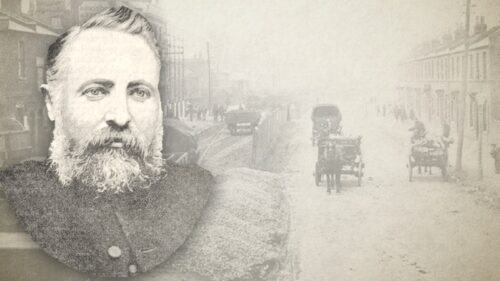
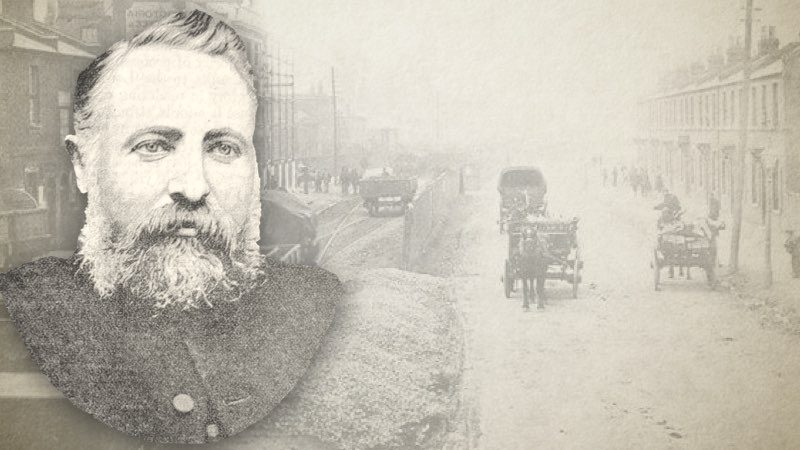
Edwin White (1846-?) was a Strict and Particular Baptist preacher. His first pastorate was with the church meeting at Orphington (1877-1879). After two years, the communion question cropped up, the majority of members deciding to throw the Table open. He forthwith resigned his office. His second pastorate was with the church meeting at Clare, Suffolk (1881-1887). After six years of blessed ministry, he resigned the office due to health reasons. His third pastorate was with the church meeting at Woolwich, Enon Chapel (1891-1919). In 1911 was elected president of the Metropolitan Association of Strict Baptist Churches.