
Divine Approval Of The Faithful
Notes Of A Sermon Preached On The Occasion Of The Death Of Mr. R. Abrahams, Who For Forty Years Was The Honorable And Honored Deacon Of The Enon, Woolwich, Strict Baptist Church, On Sunday Evening, Jan. 22nd, 1893.
“His Lord said unto him, Well done, thou good and faithful servant: thou hast been faithful over a few things, I will make thee ruler over many things; enter thou into the joy of thy Lord.”—Matthew 25:21
In reading this chapter we find in these two parables God’s people in two attitudes. First, they are waiting for the Lord. In the parable of the ten virgins we notice them waiting for the bridegroom. In the other parable, from a verse of which our text is taken, we find them serving. And thus our Lord has given us the two sides of the Christian character, waiting and service. The Christian is not of this world, therefore he is waiting for his Lord to come and take him home; but while he is waiting he is serving, and is· found as one who is very alive in the service of his Divine Master. The Lord is pleased to give gifts and talents that His people may use them for His service, and He gives a variety and number of gifts. Unto one He gives five talents, unto another two, and unto another but one. And He is not only pleased to give gifts, but also to give glory to the gifts which He has given. But the recipients take no glory to themselves, and our dear brother would not like us to place the crown on his brow, but would say, “Give it to my Lord.” And there are two things we should have—diligence and fidelity in service. Our brother, doubtless, saw many who started very diligently, but they did not continue, and he would say, like Paul, ”Ye did run well; who did hinder you that ye should not obey the truth?” We will now divide the text as follows:—I. The pleasing commendation. II. The peculiar reward. III. The perpetual joy.
I.—The pleasing commendation. “Well done, thou good and faithful servant: thou hast been faithful over a few things.” These words come from the lips of unerring wisdom; and when Christ says, “Well done, good and faithful servant“ depend upon it, it does come from unerring wisdom, for we should never have dared to say them. They come from the lips of Him who speaks that which is perfectly right and perfectly just, and when He commends He does so righteously and justly. Some are commended who do not deserve it, and others are passed by; but when the Lord does it, it is righteously done. And God has a right to speak thus. because He has given the graces, as we have already remarked, and He crowns them; therefore He has a right to say, “Well done, good and faithful servant.”
The commendation is couched in two adjectives. “Well done, thou good servant.” Good relatively, as standing in connection with the Lord Jesus Christ, for of themselves they are not good-there are none good; but when they have been washed in the precious blood of Christ they are so, for God the Father pronounces them good; the Holy Spirit and the angels all testify the same thing; but it is only by union to Christ that this is accomplished. Are we united to Him by vital, precious faith? If you are standing on your own good works you are not good, and unless you have faith in Christ there is no goodness in you. Our brother was good because he was united to Christ. They are good intrinsically. Our brother bad his heart changed long, long ago by the Divine Spirit, and therefore he was good, for he had a new heart, a clean heart, and a right spirit given to him by the Holy Ghost. They are good comparatively: good compared to what they were in an unconverted state. Perhaps I have an unconverted friend here to-night. The world can say nothing against you, you lead a perfectly moral life, but unless you have a new heart you are not good. Our brother was a different man after he was changed to what he was before. Then they are good evidentially. Whatever a man is it will show itself. Christ said, “You cannot gather grapes of thorns, or figs of thistles; ” therefore if a man has a changed heart it will show itself. A man may be obscure and unostentatious, yet it will be seen. Our brother has read the hymns sometimes with such feeling that we could see he felt what he read, that heaven was his home, and, though trembling, feeble, and weak, it was evident the good work was in him.
Then there is another adjective used-faithful. “Thou good and faithful servant.” Faithful in the trust reposed. Our Lord speaks of giving talents into the hands of His servants, and to those who were faithful He says, “Well done, good and faithful servant.” Our brother was deacon of this Church for forty years, a member for fifty-three years, and a treasurer of the Church funds for many years; and I believe that not one penny of the money was put to a wrong use. Faithful is to be trustworthy, and he was trustworthy; and that is a great thing to say, for have we not had painful experience of late of those who have stood high in profession, but they have caused trouble to very many. It also means fidelity to the Lord, attachment to His cause, to His people, to His truth; and to be faithful to the Lord is no mean thing in these days, to stand firm through good report and evil report. He never thought of swerving from the truth of God, altering the doctrines, or departing from the ordinances left by our Lord. He was not a harsh man, nay, rather, a loving brother, but he stood firm, and he was one with whom you could not easily quarrel. He told me once he had had nine men in office with him, and he had never quarrelled with any of them. A man who is faithful will have to be firm and loving, and such was our brother, I am sure. He was a faithful servant, unswerving, not turning aside. He was not brilliant, but very quiet. People think that a man will not get on if he is not eloquent, but our brother, though not brilliant, was faithful. If I am not known beyond the circle in which I move, let me be faithful to my Lord. God’s servants are faithful to the opportunities which they have given to them. I now speak to the members of this Church, and of other Churches. Did you not, when you were baptized into Christ, mean to follow Him in every way? Therefore let us embrace every opportunity. Then we must be faithful in rebuking and counselling one another. Our brother was faithful in this way.
II.—The peculiar reward. “Thou hast been faithful over a few things, I will make thee ruler over many things.” It is a peculiar reward, because of its nature. What! the Lord gives graces and gifts and then rewards them? Truly, it is a peculiar reward, to be made ruler over many things: a few things entrusted to him here, and made a ruler in that upper and better world. Then it is a peculiar reward because of its greatness. What! a ruler over many things? We are told we shall judge the angels. How wondrous! Why, it is more wonderful than that Joseph should be made next to the governor; and our brother, last Sunday evening, while we were worshipping here, his body was so weak that be had hardly strength to get up the stairs, from which he never descended until he was carried out, yet now he is a ruler and inheritor of that crown that fadeth not away. And we think of its undeservedness, that the Lord should crown the grace which He has given, and I am sure every real Christian will answer as in the thirty-eighth verse: “When saw we Thee a stranger, and took Thee in? or naked, and clothed Thee?” You know it is held by some that there are degrees of glory, and some have higher bliss than others. This may be so, but I believe it will be so glorious that we shall not envy each other; but though one has five talents and the other but two, they both received the same welcome, ”Enter thou into the joy of thy Lord.”
III.—The perpetual joy. “Enter thou into the joy of thy Lord.” The joy somewhat enters into us here, but we have to enter into that to enJoy it thoroughly. It is the joy of the Lord, and it is what our dear Lord bargained for when He entered into the plan of salvation, when He undertook to come down on earth for us. And this joy was the reward which He was to receive, and which His servants were to have; and our brother has entered into it. It is that for which the Saviour wrought for Himself and for His people. He had it in His view all the way along; while enduring the agony at Gethsemane; when on the cross at Calvary; and His people, the followers of the dear redeeming Lamb experience it. It is the joy which He entered upon when He entered heaven; He took possession of it, and Christians, when they die, enter into it and take possession of it.
“For ever with the Lord,
Amen, so let it be.”
All His people enter into this joy, and it supports them in their trials. In John 14 Christ told His disciples He was going to leave them, to go back to the country He had come from, and then He says in John 15:11, “These things have I spoken unto you, that My joy might remain in you, and that your joy might be full.” My joy! There are different kinds of joy. There is the joy of the worldling; the joy of the stony ground hearer, they who bear the word with joy, but in time of temptation fall away. But the Christian’s is a lasting joy, and it is satisfying joy, for in that kingdom are pleasures for evermore. Our brother has entered that joy; it is what he waited for. Oh, my Father has been so good to me all through life, and especially these fifty-three years!“ This was his testimony. Called by grace at the age of twenty-two; which was my age when God called me. I do not know if I shall have fifty-three years in His service, but for twenty-five years He has been good to me. Here is another sentence which came from bis lips, “all of grace;” and that will find an echo in all your hearts. This is after years of troubles and joyful leading, it is all of grace. Again, “I thought the Lord was going to take me home.” “Where your treasure is,” the Saviour said, “there will your heart be also.” He felt this was a home to him, for he loved this spot, but his home was not here, it was above. Another sentence, “He does all right. Oh, for more patience!”
Here is another of our brother’s last sayings: “Yea, doubtless, and I count all things but loss for the excellency of the knowledge of Christ Jesus my Lord.” He loved these words. One was talking to him about last Sunday night’s sermon, and he said, “What a mercy, but are we worthy? are we worthy?” Oh! my friends, here is a man with fifty-three years’ record, and he says, “Are we worthy?” If It man like that talks so, we say, Are we worthy to walk with Him in white? No, we are not, only as He makes us worthy. I have a few sentences here which are remembered to have been uttered by him at different times: “Oh, that my dear Lord would take me home to Himself!” Though he did not feel worthy, he wanted to go to Jesus. And so do I, friends, for though I am not worthy, I do want to go, and I should feel very disappointed if I did not go there.
Here are the last words which are remembered to have been uttered by him, though I have mentioned them before: “What a mercy—oh, what a mercy!” Yes, he began with that. I can imagine him fifty-three years ago beginning with that prayer, “God be merciful to me a sinner;” and now, when the darkness of death is creeping over him, it is still, “What a mercy!” What a mercy it is to be called by grace, to be kept by grace, and to have Jesus with us in the article of death. “I am going,” he said, and fell asleep; asleep in Jesus, and entered into the joy of his Lord. Oh, for grace to follow him! And if we have an epitaph on our tombstone, we should like it to be, “Well done, good and faithful servant, enter thou into the joy of thy Lord.'” Amen.

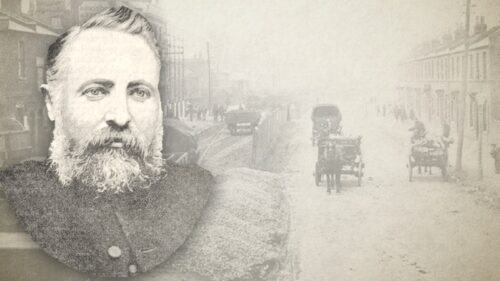
Edwin White (1846-?) was a Strict and Particular Baptist preacher. His first pastorate was with the church meeting at Orphington (1877-1879). After two years, the communion question cropped up, the majority of members deciding to throw the Table open. He forthwith resigned his office. His second pastorate was with the church meeting at Clare, Suffolk (1881-1887). After six years of blessed ministry, he resigned the office due to health reasons. His third pastorate was with the church meeting at Woolwich, Enon Chapel (1891-1919). In 1911 was elected president of the Metropolitan Association of Strict Baptist Churches.