
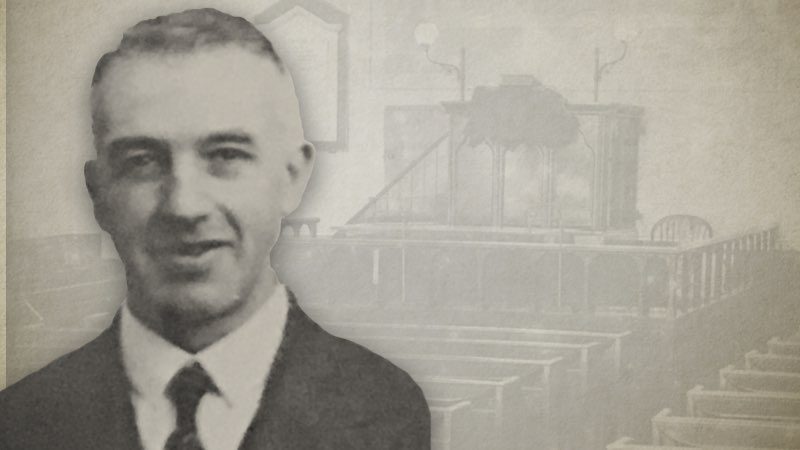
The Life And Ministry Of Benjamin Walshaw
Gospel Standard 1885:
Benjamin Walshaw, Pastor At Zoar Chapel, Bradford, For Twenty-Five Years, Died On March 19th, 1984, Aged 85.
In the previous month, he had preached one Lord’s day under particularly trying circumstances. He had expected to be a hearer, but on the Saturday was informed that the minister who had been expected was unable to fulfil the engagement through illness. On the Sabbath it was found that the heating system at the chapel had failed, so that all present were thoroughly chilled. He was strengthened and helped through the day, but the next morning suffered what seemed, at first, to be a mild stroke. In the next day or so his condition rapidly worsened, so that he was removed to hospital, where he remained for the last few weeks of his life.
Throughout his illness, he was able to speak plainly enough to be easily understood, and his mind was generally kept clear. At times he spoke of the removal to the south that had been anticipated, but more frequently he spoke of grace and glory He was graciously kept from rebellion during the affliction; and though on one occasion particularly much tried as to his standing in Christ, he was delivered from his fears so that at eventide it was light. He much appreciated visits and the prayers some were helped to express at his bedside. When it was not possible for one of the visitors to engage in prayer before leaving, he would pray himself. As he humbly committed himself and all he loved unto the Lord, there was evident that access in prayer with which he was so often favoured when in the pulpit.
His father, Robert, who was a supply minister amongst the northern churches, died when Mr. Walshaw was very young. In later years he felt much sorrow on account of the way in which he felt he had been troublesome to his widowed mother during the years in which she had been responsible for the family, of which he was the youngest. He wrote himself of those days, with particular reference to the headstrong, stubborn spirit he showed, whilst recording also that during these early years he was the subject of some remarkable deliverances from severe injury on several occasions.
He enlisted in the army in 1915 whilst still only sixteen years old. As his mother at about the same time decided no longer to keep up the family home, he had a rather unsettled life thereafter until his marriage in 1924. During part of this period he lived at Middlesbrough. While he was there, the Lord was pleased to work through the testimony of a few of His people telling him of the Lord’s work in their souls. He was brought to feel his own lack, and as the work was deepened came under a heavy burden because of his sins. He was brought to justify God, even as he felt ready to sink under this burden.
One Lord’s day evening as he went to chapel, he was so near despair as to say he would never go again unless he felt to receive some blessing. At the end of the service, having received nothing, he was afraid to move and begged that he might not be left to go into the blackness of darkness for ever. Though feeling unfit even to witness the ordinance, he stayed to do so for the first time, and was greatly blessed through the Lord’s power attending the opening hymn:
“Hark! from the cross a gracious voice
Salutes my ravished ears.”
In a letter written many years later he wrote:
“I do remember the time when I could solemnly justify God even in sending my soul to hell: it was a due reward; it was a just payment, the wages of my sins. How near I felt to despair! The blackness of darkness for ever was a real condition feared not a theory . . . The verse in hymn 1040 was my case and condition:
‘When we lay in sin polluted.
Wretched and undone we were;
All we saw and heard was suited
Only to produce despair;
Ours appeared a hopeless case;
Such it had been, but for grace.’
O, how a look from the cross turned a dying sinner with all the due reward of his deeds to a dying Saviour! O what a look there was here! Here is a Saviour who has come where I am, who knows what it is to thirst as I do now, to feel God-forsaken as I do now—with this great, this vital difference: “But this Man hath done nothing amiss.” What sweet wonders, what deep mysteries shine through this appointment—my sins by imputation His, and His obedience mine! How the Lord changed in a moment the fears and torments of hell to the hope of joys in heaven! So it was with my poor soul that Sunday evening.
‘Yes, now I know ’tis He, ’tis He!
Tis Jesus, God’s dear Son,
Wrapt in humanity, to die
For crimes that I had done!
O, blessed sight, O lovely form.
To sinful souls like me;
I’d creep beside Him as a worm,
And see Him bleed for me.’
Shortly after this time, under the sweet enjoyment and constraint of the time of first love, he was baptized, remaining in membership with the church then at Middlesbrough until in the ordering of providence he settled at Brighouse and his membership was soon afterwards transferred to Bradford.
During the next twenty years or so he was called upon to undertake various responsibilities, conducting the Bible Class and holding office as deacon and as Sunday School superintendent. He was also asked to preach on more than one occasion, but declined, feeling he had no warrant to go forward. Early in 1944, however, he received a further invitation to preach, and was not able to put the matter away. In the months following he passed through much exercise, feeling the solemnity of the work and yet receiving seasonable direction and encouragement through the ministry of Mr. Davenport, Mr. Vaughan, and others. He felt strongly that when matters were of the Lord, a church would be exercised with regard to the sending into the ministry of one who was exercised with regard to being sent. Hence, despite gracious tokens and answers given to his prayers, he did not feel it would be right to go without the full agreement of the church at Bradford. This was given after he had preached before his own people on three occasions.
So commenced a ministry of nearly forty years, exercised mainly among the northern churches, but extending to a number of midland churches and further afield also on special occasions. His extensive correspondence was another means by which his ministry reached a wider circle than his congregation at Bradford.
His pastorate, like his entry into the ministry, followed much exercise. Shortly before the call from Bradford, he had two other calls. At one of the other churches his ministry had been much blessed, but nevertheless the Lord made it clear to him that this way was closed. With regard to the other church, however, there did not for a time seem to be any clear direction. Whilst perplexed, he was tempted to conclude that there was nothing in the Scriptures that could give him the direction he needed. In due time, however, the matter was settled for him by divine power applying the words: “Their nobles shall be of themselves, and their governor shall proceed from the midst of them; and I will cause him to draw near, and he shall approach unto Me; for who is this that engaged his heart to approach unto Me, saith the Lord. And ye shall be My people, and I will be your God.”
During the earlier years of his pastorate there were times when the Lord was pleased to confirm His Word by signs following. In later years there were seemingly more discouragements than encouragements, but the Lord graciously supported him, enabling him to sow beside all waters; and living souls were fed through the Christ-exalting ministry.
One of the last occasions possibly the last occasion when he spoke other than at Bradford was at the Societies’ Northern Meeting in September 1983, when he conducted the prayer meeting. He read Psalm 90, and after speaking briefly of the Lord’s dealings with Israel, of Moses the lawgiver, and the law as schoolmaster to bring to Christ, he concluded his remarks as follows:
“And I believe we shall prove that from Moses to Christ is a very, very blessed step. Christ hath redeemed us from the curse of the law. Christ has brought the liberty and promised heaven where His people shall dwell. Thou hast been our dwelling place My dear friends, I hope we shall know the blessedness of that good that the Lord has promised to His people who are called by His name.”
Had he lived a little longer, he would have completed sixty years’ membership at Bradford, and also sixty years’ married life. He was, however, taken to be with Christ, which is far better, to prove the fulness of a word he often quoted in family prayer: “When I awake, I am still with Thee.”
H. D. H.
Benjamin Walshaw (1899-1984) was a Strict and Particular Baptist preacher. He served thirty years as pastor for the church meeting at Zoar Particular Baptist Chapel, Bradford (1954-1984). He was also a regular contributor for the Waymarks Magazine.

