

The Good Shepherd
[Posted by permission. Bethel Strict Baptist Chapel.]
Sermon preached at Bethel Chapel, Luton, by Mr. B. A. Ramsbottom, on Lord’s day evening, 7th November, 2021
“I am the good Shepherd: the good Shepherd giveth His life for the sheep”—John 10:11
This is one of those glorious I ams of our Lord and Saviour Jesus Christ. Really, all of them are precious. “I am the Door”; “I am the Resurrection and the Life”; “I am the true Vine.” So we might go on. “I am the Way, the Truth, and the Life.” And here, “I am the good Shepherd.” “I AM,” as revealed to Moses at the burning bush, is the name of Almighty God, and it can never be given to any other. It speaks of His eternal, everlasting, unchanging character, the great I AM.
I think if you stop and you look at these various I ams, every single one of them has a very beautiful suitability to our need, as we feel our unworthiness. We feel dead – “I am the Resurrection and the Life.” We are not so sure of the way – “I am the Door.” So we might go on. Here, this one which has always been very precious to God’s people, and often very precious to God’s little ones. I think that is because it speaks so much of His love, and His kindness, and His gentleness, and His tenderness, and His care.
“I am the good Shepherd: the good Shepherd giveth His life for the sheep.” Now in seeking to bring this lovely word before you this evening, there seems to me to be a natural, threefold division. First, the Shepherd; second, the sheep; third, the Shepherd dying for the sheep. “I am the good Shepherd: the good Shepherd giveth His life for the sheep.” In one place, our Lord Jesus is spoken of as the Chief Shepherd. In another place, He is spoken of as the great Shepherd. But here, the good Shepherd.
I want to linger a little on this at the beginning, because the goodness of God is one of the great themes of holy Scripture. We have it right through the Old Testament and right through the New. “The goodness of God endureth continually.” Now not all shepherds were good. There is so much in Ezekiel about the false shepherds, the bad shepherds, who ill-treat the flock, who lead the flock astray, and of course in the New Testament, references to the scribes and Pharisees. They were bad shepherds. But with the Lord Jesus, “I am the good Shepherd.” The wonderful thing about Him being the good Shepherd is this: that He has a blessed ability to give this goodness. He delights to give this goodness to poor, unworthy sinners who have no goodness of their own.
That is why I felt I would read those few verses in the well-known Psalm 23. This is David speaking, and in the last verse, what is he speaking about? That he has received goodness. He has received it from the Lord. It has come to him from the good Shepherd. It could not come from anywhere else. “Surely goodness and mercy.” He is so thankful he has received it. It is a wonderful truth. There are some of the Lord’s attributes that He does not really give to other people; they belong to Him and Him alone. But His goodness – well, what did He say to Moses? “I will make all My goodness pass before thee.”
“Goodness, immortal and divine,
The bliss of endless day.”
So David could conclude this little Psalm, “Surely goodness and mercy shall follow me all the days of my life: and I will dwell in the house of the Lord for ever.”
“I am the good Shepherd.” And the Lord is good whatever He does.
“Good, when He gives, supremely good,
Nor less when He denies;
E’en sorrows, from His gracious hand,
Are blessings in disguise.”
“I am the good Shepherd.” Now there is so much about the goodness of God revealed in Christ in Scripture. We could spend a lot of time thinking of various references, but there has just been one on my mind which seems to be a very special one: “The Lord is good, a strong hold in the day of trouble; and He knoweth them that trust in Him.” “The Lord is good.” That is a wonderful thing to those of you who are in trouble. “The Lord is good, a stronghold” to you. “Turn you to the strong hold, ye prisoners of hope.” What a wonderful thing, “He knoweth them that trust in Him”! Of course, He knows those who do not trust in Him, but those of you wanting to prove that you do trust in Him, you want to know that you trust in Him and to be assured of this: the Lord “knoweth them that trust in Him.” May you and I be favoured to be found amongst them, those who through grace trust in Him.
“I am the good Shepherd.” And the goodness of the good Shepherd is specially known in His loving, tender care for His sheep. It has often been said that when this chapter was first written, it would come very close to Jewish readers. They were all familiar with this. It was a daily sight, the shepherd and how he cared so lovingly and tenderly for his sheep. It would have been something so plain, much more than to us in a different country, a different climate.
O but the goodness of the Lord Jesus, His watchful care! When His sheep wander, going after them, bringing them back; when they fall, lifting them up; when they are wounded, restoring them; defending them from the wolves and the bears; keeping them by His power; supplying all their needs day by day. This is the special way in which the Lord’s goodness is made known. He is good, but day by day His goodness in caring for His sheep is made known, and it is not something He does one day and then He drops another.
I think I have told you, I had an old great aunt who came up to Lancashire to live from the south, and she said her old grandfather was the shepherd of the village, and she only remembered him being ill on one occasion, in bed on one occasion, and they could not control him! He was restless. He kept saying, “I must get up. I wonder what is happening to such a sheep,” and there was another one that needed special care. They had no peace till he was back with his little flock. It is no wonder the Lord Jesus once said, “Fear not, little flock.” There is nothing to fear if they have a good Shepherd. “Fear not, little flock; for it is your Father’s good pleasure to give you the kingdom.”
“I am the good Shepherd.” One thing that seems to be specially noticeable in the East, and it is mentioned at the beginning of this chapter, is this custom of a good shepherd in the East leading his flock, going before them; not driving them. He goes before and the sheep follow Him. I think some of us at times have found that truth to be precious: “When He putteth forth His own sheep, He goeth before them, and the sheep follow Him.” The good Shepherd at times puts forth His own sheep. He puts them forth in a way they have never gone before. He puts them forth with some special exercise of spirit. Perhaps some of you are in it now. Sometimes He puts them forth to walk in a difficult way, a pathway of trouble. But this is it: “When He putteth forth His own sheep, He goeth before them.” If the Lord is putting you forth at present in some gracious exercise – seeking His leading, praying for guidance, wanting to follow Him – be sure of this: if the Lord Jesus is putting you forth, He will not leave you. He will always go before you to lead you aright. “I am the good Shepherd.” Well, so many beautiful, blessed things might be said about the good Shepherd, and especially, not least, about His goodness.
“I am the good Shepherd.” Now the second thing: the sheep. Now they are not good. Jesus said, “I am the good Shepherd,” and He has His little flock of sheep, His chosen ones, but they are not good. Sheep – how easily they fall, and when they fall, they cannot get up. How easily they go astray. How easily they wander out of the way. How foolish sheep are. And the word says, “All we like sheep” – every one of us, the whole human race – “All we like sheep have gone astray; we have turned every one to his own way.” So if the Shepherd is good, supremely good, then the sheep are not! What an opposite there is here: the sheep of Christ’s fold, and yet He loves them.
Always remember one thing: if you ever see some sheep, whether it is a flock together or just one out on the hills or mountains, if you see a sheep, it always belongs to someone. Sheep are creatures that belong to someone. They have an owner – some of them, many, many miles over the mountains. I remember years ago when I was a boy up in the Lakes, we were talking to a Lakeland shepherd and he said when they did the round-up of the sheep once a year, they found some of their own sheep had wandered twenty miles, but they still belonged to that shepherd; they were still his sheep.
The shepherd and his sheep. In that very remarkable book by a man named Dr. Thomson, which was written in the 1900’s, The Land and the Book. He was a minister in Israel for thirty years, and in the book he wrote of all the happenings and the habits. He once saw a shepherd and he was leading his flock to a river, and he was leading them to the ford which safely crossed the river. As he watched, what happened? Some of them wanted to get in front; some of them wandered a bit to one side or the other; they tried to cross the river where it was not the ford. The poor shepherd had to leave most of his flock and go after his sheep that had wandered out of the way. He had to go into the water himself and swim and bring them back.
“Prone to wander, Lord, I feel it;
Prone to leave the God I love.”
But there is a wonderful blessing in being a sheep of Christ’s fold! We are not there by nature, not in our experience. In the eternal counsels of God in the covenant of grace, His people always were chosen sheep, but by nature He sees them wandering upon the dark mountains, to use a phrase of Scripture – wandering upon the dark mountains. And what does He do?
“There is a period known to God
When all His sheep, redeemed by blood,
Shall leave the hateful ways of sin,
Turn to the fold, and enter in.”
The good Shepherd delights to go after the lost sheep. We have it in the parables. He cannot be satisfied till He finds the lost sheep and brings it back with rejoicing to the fold. Now that is it. Surely most graciously- exercised hearers love to hear of the good Shepherd. They love to hear of His little flock, the flock He loves and cares for, but they want to know whether they are one of the flock, and how do I become one of the flock? Well, it is as the Shepherd finds them, and really He teaches them their need, and the great point He teaches them is that they cannot do without Him; they cannot be saved without Him; they cannot be forgiven without Him; they cannot get to heaven without Him.
Now I wonder how many of you have come to that place, when you feel your vital need of Christ as the great Shepherd to save you, to bless you with what He says here: “I am come that they might have life, and that they might have it more abundantly.” So every lost sheep is found and every lost sheep is sweetly enabled to go after the Shepherd that found it, and never to leave that Shepherd, to seek to follow Him all the days of its life. There is something very precious in this picture. There is a union here that can never be broken, the Shepherd and His beloved sheep – so unworthy, but chosen, redeemed by blood, sanctified by the Spirit, “saved in the Lord with an everlasting salvation.”
It is laid on my spirit just to say a word or two to any boys and girls, any young people here, and you see a beauty in the teaching of the Scriptures about the Lord and Saviour Jesus Christ being the Shepherd of the sheep. Am I right in saying, what you would really like is this: for the Lord Jesus not just to be the Shepherd of the sheep, but to be your Shepherd? I have pondered this point. There is nothing in Scripture to forbid someone who is concerned, going in prayer to the Lord Jesus and saying, “Lord Jesus, wilt Thou be my Shepherd, and do for me everything that a shepherd does for his sheep?” I have thought about it. There is one prayer which says, “Lord, be Thou my Helper.” It is a little, simple, nice prayer. “Lord, be Thou my Helper.” Well, likewise as you are helped by the Spirit, you can say, “Lord, be Thou my Shepherd,” and I do not think the Lord Jesus will be offended. It is the one thing you really want – the Lord Jesus to look after you.
It makes me think, I have told you about that little dwarf at one of our chapels. He never spoke a word to any human person, but he never began to eat his breakfast or his dinner without praying, and he prayed out loud, and he always ended like this: “Please do look after me, Lord; do look after me!” Well, that is what the good Shepherd does. That is the thing we want Him to do for us.
It brings us to our third point. The Shepherd, the sheep – “I am the good Shepherd: the good Shepherd giveth His life for the sheep.” Now let us be clear: in one sense this is just a personal, well-known reference. There were good shepherds in the East, and they loved their sheep so much that if the wolf came, or the bear, they were even willing in struggling for the safety of a little lamb which had been captured and carried away to lay down their life. That is the natural meaning of it.
“The good Shepherd giveth His life for the sheep.” But really the whole glorious doctrine of the atonement is here, the Lord Jesus dying for sinners. I came across one of the old writers recently and he said, “Have you noticed that so often the Lord Jesus loves to slip something in concerning His approaching sufferings and His approaching death?” Because this is the vital point: if the Lord Jesus says, “I am the good Shepherd,” this is the supreme display of His goodness. His goodness is shown in many ways, but never so much as when He went to the cross to lay down His life that His poor sheep might be redeemed by His death.
“The good Shepherd giveth His life for the sheep.” If there is an emphasis here in this closing clause, it is the willingness of the Lord Jesus to die. It is not like some martyr’s death. They were brave, but their life was snatched from them. The Lord Jesus willingly went to the cross to die in His people’s place. How clearly He puts it here: “No man taketh it” – My life – “from Me, but I lay it down of Myself. I have power to lay it down, and I have power to take it again. This commandment have I received of My Father.” You remember when He was in the garden and they came to arrest Him, how willing He was to die. He said, “Whom seek ye?” And when they said, “Jesus of Nazareth,” He said, “I am He.” They fell prostrate on the floor. “Then asked He them again, Whom seek ye? And they said, Jesus of Nazareth.” He gave the same glorious answer: “I am He.”
“It were an easy part
For Him the cross to fly;
But love to sinners fills His heart,
And makes Him choose to die.”
It is that willingness, that loving willingness.
And then you remember when He was brought before Pilate, and what Pilate said he could do, and he said, “Knowest Thou not” – this is Pilate – “that I have power to crucify Thee, and have power to release Thee?” The Lord Jesus said, “Thou couldest have no power at all against Me, except it were given thee from above.” Again He said, “Thinkest thou that I cannot now pray to My Father, and He shall presently give me more thantwelvelegionsofangels?” Whataneasythingitwouldhavebeenfor the great Shepherd to escape from the cross!
We sing,
“But love to sinners fills His heart,
And makes Him choose to die.”
“How willing was Jesus to die,
That we fellow-sinners might live!
The life they could not take away,
How ready was Jesus to give!”
“The good Shepherd giveth His life for the sheep.” So we see the Saviour dying. We see His matchless love. He takes the dying sinner’s place; He suffers in his stead. He bears the wrath of God that His people deserved, that His sheep deserved. “He is brought as a lamb to the slaughter, and as a sheep before her shearers is dumb, so He openeth not His mouth.” Behold the Man in His silence! But O the agonies He suffered – the crown of thorns, the cruel nails, the spear, the deeper sorrows of His holy soul, till He bowed His head in death. But this was it: He was shedding His precious blood to make atonement for sin. “The Good Shepherd giveth His life for the sheep” – the supreme display of His goodness and His matchless love.
“I am the good Shepherd: the good Shepherd giveth His life for the sheep.” But that is not the last word. The last word concerning the good Shepherd does not leave Him in the grave. Listen to those wonderful words of the apostle at the close of the Epistle to the Hebrews. “Now the God of peace” – listen to it: “Now the God of peace, that brought again from the dead our Lord Jesus, that great Shepherd of the sheep, through the blood of the everlasting covenant.” And then the application: “Make you perfect” – this is the result of the good Shepherd giving His life for the sheep, as He rose again triumphant: “Make you perfect in every good work to do His will, working in you that which is wellpleasing in His sight, through Jesus Christ.” And we leave our thoughts on the good Shepherd here: “To whom be glory for ever and ever. Amen.”
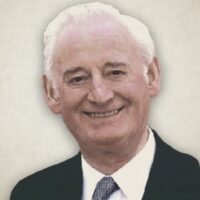
Benjamin Ramsbottom (1929-2023) was a Strict and Particular Baptist preacher. In 1967, he was appointed pastor of the church meeting at Bethel Strict Baptist Church, Luton, Bedfordshire, a position he held for fifty-five years.