The Lord Jesus In Control
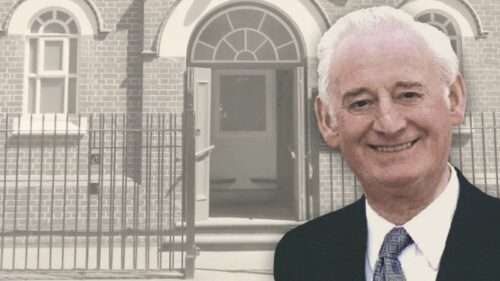
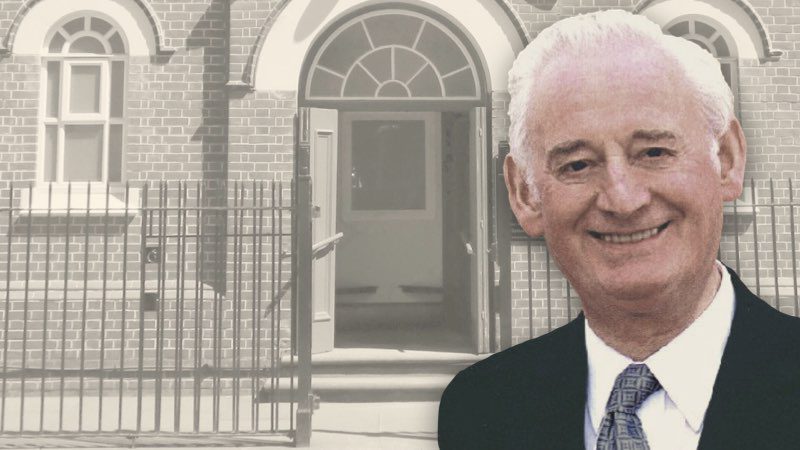
[Posted by permission. Bethel Strict Baptist Chapel.]
Sermon preached at Bethel Chapel, Luton, by Mr. B. A. Ramsbottom, on Lord’s day evening, 24th October, 2021
“For He Himself knew what He would do”—John 6:6
Special emphasis is laid in the Word of God on the feeding of the five thousand, all these events in this chapter, the wonderful miracle that took place. What is outstanding: of the Lord’s many miracles, this is the only one which is recorded in each of the four gospels. So there is no vain repetition with the Lord, and if anything is repeated, it is because the Lord Himself would place a special emphasis on it, and on its importance.
First of all this evening with the Lord’s help, thinking generally of this wonderful, well-known miracle, the feeding of the five thousand, there are three very important points I would bring before you. The first is this: this was a display of God’s divine, almighty power. To think that that five thousand should be fed, and in such an amazing way, when they had nothing to feed them with! No-one but the Son of God could have accomplished this. And the wonderful thing when we read these miracles: to think it is this same Jesus today, the Lord Jesus we worship, and with whom we meet together, we hope to serve. “This God is our God for ever and ever.”
As we think of this wonderful miracle and this display of God’s almighty power, we think of the whole theme of omnipotence. Now you young ones know what omnipotence means. It means that God is able to do anything; God is able to do everything. Of course, we always think of the old saying: “God cannot lie; God cannot die; God cannot deny Himself.” And so when we say that the Lord can do anything, can do everything, we understand what we mean.
I thought about this, not just today, but during the last few weeks, concerning the much affliction we have had at Bethel, those of you recovering, those of you still troubled, those of you with things before you, and then the Covid which has been sweeping around and through us. Then we hear of new things, we hear of different things. But to remember that this God of John chapter 6 is still almighty, He is still on the throne, He still lives, He still reigns, and with Him still nothing is impossible.
But I often go back to Isaiah 40. He holds the mighty waters of the sea in the hollow of His hand. You cannot hold much water in the hollow of your hand. He holds the mighty oceans in the hollow of His hand. He metes out – He measures out – the heavens with His span. You cannot stretch the span of your hand very far. He measures the heavens with His. The mighty nations of the earth – you think today, Russia, China, the United States – the mighty nations of the earth before Him are like a drop of a bucket. There is not much, when you speak of a drop in a bucket. Many years ago I was speaking for the Trinitarian Bible Society. I was corrected on that. They said I quoted Scripture wrong. I said, “What did I say wrong?” They said, “You said, ‘A drop in a bucket’; it says, ‘A drop of a bucket’” – the drop that runs down the outside. There is nothing in the bucket. “He taketh up the isles as a very little thing.” You see our great God and Saviour, the God of John chapter 6, is the God of Isaiah chapter 40.
I would like you younger ones to seek to be led by the Holy Spirit to have clear views of how almighty God is. It is an easy thing to say. Surely it is one of the first things we learn in Sunday school. But to have a time in your life, if it is only once, when you get a real view of the divine, almighty power of your God! Well, that is the first thing concerning this interesting chapter: the display, the wonderful display of the power of God in performing this amazing miracle.
Now the second thing that stands out to me is the compassion of the Lord Jesus. It is a beautiful subject: compassion.
“This was compassion like a God,
That when the Saviour knew
The price of pardon was His blood,
He pity ne’er withdrew.”
That was the greatest display of compassion. But it is the tender-hearted Jesus. It is His kindness. It is His mercy. It is the way He understands.
It was towards evening. The shadows of evening were coming on, and there was this great multitude there. In another of the gospels, the disciples came to the Lord Jesus and they besought Him to send the multitude away that they might find something to eat, that they might be satisfied. It seems perhaps the disciples did not know what to do. In one sense, they wanted to get rid of them. And then we have that majestic word from the Lord Jesus: “They need not depart.” Well, it was a shock to the disciples. “They need not depart; give ye them to eat.” O the impossibility of it! But the Lord’s compassion will find out a way. You cannot separate His tender heart from His divine, almighty power. One of our hymns says something like this:
“Look to Jesus, kind as strong – Pity joined with power.”
O these things that God has joined together; let no man put them asunder. It is a beautiful subject. We could go on speaking about it; it is something for you to go home and think about: the compassion of the Lord Jesus. We are told His heart is full of compassion.
And then the third thing in this interesting chapter I would bring before you: the Lord supplied not just the needs of His immediate followers, but He supplied the needs of all those who were there listening to Him. Some of them were ungodly people – it seems that many of them were, perhaps most of them were – but the Lord still supplied their needs. It is that point we touched upon this morning concerning the harvest: He causes the rain to fall on the righteous and on the wicked. He opens His hand; He satisfies the desire of every living thing. That is what He did here. He satisfied the desire of every living thing, though He solemnly said to them afterwards, “Ye seek Me, not because ye saw the miracles, but because ye did eat of the loaves, and were filled.”
But the supply of all these needs, and they were not easy things; they were difficult things; you might say, impossible things. If the Lord did this for this mixed multitude, what shall we say of that wonderful promise: “My God shall supply all your need”? He has the ability to do it and He has the willingness to do it. “My God shall supply all your need according to His riches in glory by Christ Jesus.” That is the never-failing treasury from which He supplies His beloved people’s needs. I wonder what your needs are this evening. May you be reminded of that promise. Of course, really it is an opening up of the well-known word we have in the account of Abraham and Isaac: Jehovah Jireh – the Lord will provide.
Well, just to begin this evening, these three striking points in this wonderful miracle: the almighty power of the Lord Jesus, His tender heart and His compassion, and His ability to supply every need.
Now let us look more closely at the word. “When Jesus then lifted up His eyes, and saw a great company come unto Him.” Let us be clear: He knew why they had come to Him, and this great company were the five thousand. We always say, “The feeding of the five thousand,” but do not forget the Word of God says, “Five thousand men, beside women and children.” He asked Philip a question. You can go to the godly commentators. They will tell you all kinds of reasons why the Lord Jesus put the question just to Philip, but we leave that. The question was this: “Whence shall we buy bread, that these may eat?” We do not use this word whence much today. We tend to say, Where from, or something like this. But it is a scriptural word, whence.
Whenever I read this little word whence, I cannot help but go back to our well-loved Psalm 121: “I will lift up mine eyes unto the hills, from whence cometh my help.” What is the source? Where are things coming from? If it is help, where is it going to appear? “I will lift up mine eyes unto the hills, from whence cometh my help.” In your pilgrimage heavenwards, I think you will often come across this word whence in your soul’s experience. Where are these things going to come from? They are promised, but where are they going to come from? “My help cometh from the Lord, which made heaven and earth.”
“He saith unto Philip, Whence shall we buy bread, that these may eat?” And then we are just told in passing, “This He said to prove him,” because the Lord Jesus knew the answer. But what did Philip do? He started doing a terrible lot of calculating. He worked in his mind how many were there, how much bread they would need, how much that bread would cost. If they spent two hundred pennies, well, it was not any answer to the problem at all. His calculating did not do a lot of good. Sometime we start calculating when we have difficulties, but it is better if we can leave our calculating and turn to the Lord. “Philip answered Him, Two hundred pennyworth or bread is not sufficient for them, that every one of them may take a little.”
And then, “One of His disciples, Andrew, Simon Peter’s brother,” he spoke; he had a suggestion, but he was not very sure of his suggestion. He had been looking around. He said, “There is a lad here, which hath five barley loaves, and two small fishes.” But the problem is not answered. “What are they among so many?” What was Andrew doing? He was not calculating. He was looking about and looking at things. He was not looking to the Lord Jesus. He was not looking to divine, almighty power. He was looking at things.
There is a scripture in the epistles. Paul said, “We look not” at all these things that everybody else is looking at. We cannot help seeing things, but we are not to look at them, especially not to look at them for help, not to look at them for the supply of our need. Paul says, “We look not at the things which are seen, but at the things which are not seen: for the things which are seen are temporal; but the things which are not seen are eternal.” How often this is where our faith fails. Instead of looking upwards, heavenwards, Christwards, it looks around, and sometimes even within, sometimes at things in ourselves. But really these two disciples, with all their good thoughts and all their well meaning, they did not help at all.
Then we have this sublime statement: “He Himself knew what He would do.” He always did; He always does. He always knows the end from the beginning. He knows before things are coming to pass, what is going to come to pass. He knows your tomorrow as much as you know your today. He knows what is going to happen. He knows what should be done. He knows what can be done. He knows what will be done. He knows that He will do it. But whatever it is, or whoever else does it, nothing can be done apart from the divine permission of this almighty God and Saviour.
“He holds all nature in His hand;
That gracious hand on which I live
Does life, and time, and death command,
And has immortal joys to give.”
May you feel this evening in all your concerns, your spiritual troubles, your tomorrow and next week troubles, your medical troubles, your family troubles, your fears, “The Lord God omnipotent reigneth.” Everything is in His hand and He can do the most impossible thing just as easily as you can do the simplest thing.
I feel this is one of the remarkable words of Scripture. It speaks of the Lord on the throne, the Lord in control, nothing at all taking Him by surprise. All these things that were troubling Philip and Andrew, all this great multitude, did not take Him by surprise. Those things in your life, those things in mine, the unknown way, it is all known to Him, the end from the beginning, nothing taking Him by surprise, and nothing can take place apart from His divine permission. “My times are in Thy hand.” It is a well- known word. “My times are in Thy hand.” And one hymnwriter puts it, “My God, I wish them there.” We would not have them anywhere else. What would we do, where would we be, if we had the key to the unknown way, we could open every door, we could shut every door, we could make every choice? We would think we could make no mistake in our choices. But the keys are in His hand.
“The keys of death and hell
Are to our Jesus given.”
That is why we can sing,
“Rejoice, the Lord is King.”
O what a word this is – so short, so simple: “This He said to prove him.” Let there be no mistake, let no-one think the Lord Jesus was saying this because He was not sure what to do, because He was a bit bewildered, because He did not know. He always knows. But the godly writer has made it clear: the only reason the Lord spoke in this way was to prove His disciples. “For He Himself knew what he would do.” May the Lord in love and mercy impress this word on our hearts. May we be able to carry it with us tomorrow and in the unknown way, and as we seek to carry it, may we be able to leave it all in the Lord’s hand.
“Leave God to order all thy ways,
And trust in Him what e’er betide.”
“This He said to prove him: for He Himself knew what He would do.” What was the very next thing that the Lord Jesus said? “Make the men sit down” – divine authority, the Lord in control.
Now there is one other thing I want to speak about this evening before closing, and it is on a very important, a vital subject. There was the feeding of the five thousand with the bread and with the fishes, but afterwards there was the application, and the application came from the Lord’s own lips. He spoke of something more important than just the bread and just the fishes and just having a nice meal, and just being satisfied. He spoke of everlasting things. The people, when they found Him again, said, “Rabbi, when camest Thou hither?” The Lord came right to the point: “Ye seek Me, not because ye saw the miracles, but because ye did eat of the loaves, and were filled.” There is something more important. “Labour not for the meat which perisheth, but for that meat which endureth unto everlasting life, which the Son of Man shall give unto you.” And then the Lord Jesus came right to the very point: “Verily, verily, I say unto you … My Father giveth you the true bread from heaven. For the bread of God is He which cometh down from heaven, and giveth life unto the world…. I am the Bread of life: he that cometh to Me shall never hunger; and he that believeth on Me shall never thirst.” If you will, that is the conclusion of the feeding of the five thousand. It is the gracious application that our Lord and Saviour Jesus Christ Himself gives.
“I am the Bread of life.” You young ones, you children know that there are a lot of times when our Lord Jesus said, “I am.” “I am the good Shepherd”; “I am the true Vine.” I am sure you can think of quite a few. “I AM” is the wonderful name that Almighty God gave to His servant Moses when Moses said, Who shall I say has sent me? “I AM.” What does it mean? The eternal, the everlasting, unchanging God. “I am.” And then when the Lord Himself speaks of it, He adds a little bit, and the little bit He adds is what suits the needs of every living soul. For instance, they are prone to wander, but, “I am the good Shepherd.” Here you have it: every one of them is brought to be dissatisfied with the best here below, brought to hunger and to thirst, something that only the Lord can give. This is it: “I am” – this is the answer – “the Bread of life.”
So personally, by nature, we hunger after all kinds of things. We hunger after pleasure. We hunger after happiness. We hunger after success. Some people hunger after a name. Some hunger after fame. But the Lord will never allow His own beloved people to be satisfied with these things. Why? The Holy Spirit will come and show you, teach you, you have an aching void the world can never fill. You know what an aching void is. If you are ever terribly hungry, you have not had anything to eat, there is something inside you: it is an aching void; it is empty; it has to be filled; it has to be satisfied. Gold and silver will not satisfy you. You must have something to eat, if only a little. That aching void. And then the gospel makes known the Bread of life, the blessed ability of the Lord Jesus to satisfy this aching void that the world never can, but not only that the Lord can satisfy it; He delights to satisfy it. He says, “Blessed are they which do hunger and thirst after righteousness: for they shall be filled.”
But what is it? What is this hungry soul on about? Well, he has to die. He is not ready. He has a soul to be saved or lost. He cannot find any help, any satisfaction. He cannot save himself. And then the glorious gospel comes and reveals the perfect Saviour who has done everything for His people – shed His precious blood, lived a life of righteousness, died for them, risen again, done everything for them. He speaks that beautiful word which we read this evening: “And him that cometh to Me” – that is these hungry ones – “Him that cometh to Me I will in no wise cast out.” If Jesus as the Bread of life means anything, it means He is able to satisfy, and He is willing to satisfy, and He invites hungering, longing souls to venture on Him and be satisfied, not in a legal way, just in a gospel way. You know what it is:
“Lo! glad I come; and Thou, blest Lamb,
Shalt take me to Thee as I am;
Nothing but sin I Thee can give;
Nothing but love shall I receive.”
That is the feeding with the Bread of everlasting life. “And Jesus said unto them, I am the Bread of life: he that cometh to Me shall never hunger; and he that believeth on Me shall never thirst.”
Jesus those happy souls does bless,
Who hunger for His righteousness;
Who seek the smilings of His face,
And thirst for fresh supplies of grace.
They cannot here contented live
On all the dainties earth can give;
Their souls can feast on nothing less
Than Christ’s eternal righteousness.
Some sweet foretastes they have below,
But the bright world, to which they go,
Will them a glorious banquet yield;
There shall their souls be ever filled.
May this my blest experience be;
To hunger, Lord, and thirst for Thee,
And on Thy righteousness to live,
Which can both food and comfort give!
Then when at death my soul shall rise
To the blest banquet in the skies,
I shall partake the heavenly store,
And feast and sing for evermore.
S. Medley
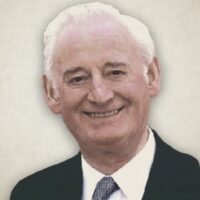
Benjamin Ramsbottom (1929-2023) was a Strict and Particular Baptist preacher. In 1967, he was appointed pastor of the church meeting at Bethel Strict Baptist Church, Luton, Bedfordshire, a position he held for fifty-five years.