The Law And The Gospel
[Posted by permission. Bethel Strict Baptist Chapel.]
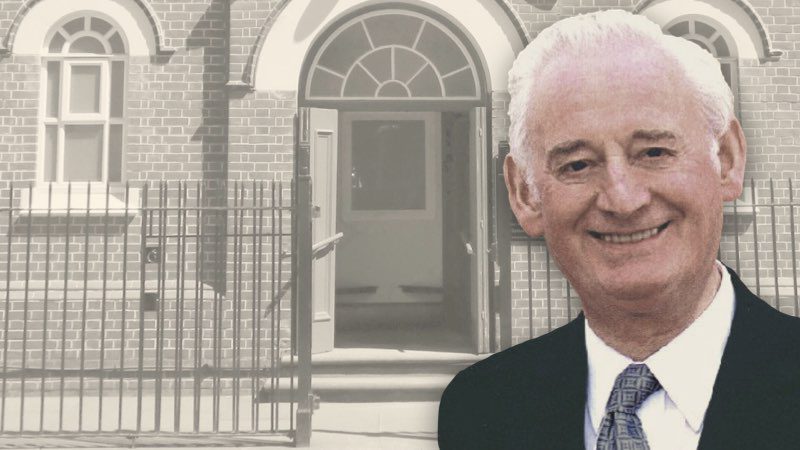
Sermon preached at Bethel Chapel, Luton, by Mr. B. A. Ramsbottom, on Lord’s day morning, 13th December, 2020
“For the law made nothing perfect, but the bringing in of a better hope did; by the which we draw nigh unto God”—Hebrews 7:19
There are three short, sharp statements in this verse: “The law made nothing perfect”; “The bringing in of a better hope did”; “We draw nigh unto God.” Some of you younger ones, some of you children, when this verse was read, might not find it easy to understand. But I hope to be able to speak to you this morning about the beautiful simplicity that is in it. There is the whole of the gospel here. There is the ground of a sinner’s hope of heaven here. There is the way into the Lord’s presence and into heaven at last here. Really, beloved friends, there is everything in this verse that a living soul feels to need, all those things you are seeking after – in providence and those vital things concerning your never-dying soul and eternity.
So with the Lord’s help we will look at these statements one by one, and let us be clear: they are vital statements. “For the law made nothing perfect.” I will come to the end, the application of it, before I seek to expound it. It really means that we have not got the slightest hope of salvation in anything whatsoever we can do. We cannot do anything to contribute to our own salvation.
Well then, the law. God has given a holy, righteous law. The commandment is righteous and good. You all know what the law is – in its simplicity, the ten commandments. In its solemn simplicity, Do this and you shall live; do it not, and dying you shall surely die; the commandment to love the Lord our God with all our heart and mind and soul and strength, to love our neighbour as ourselves. Now that law is good. God Himself gave it. But that law can make nothing perfect. It cannot bring in perfect salvation. It cannot bring in perfect hope. It has not any power to save. It shows us where we are wrong, but it cannot make anything perfect for our salvation, and it most certainly cannot make you and me perfect.
“The law made nothing perfect.” If it never went beyond the law, then all of us are condemned. You think of that beautiful word in Romans 8: “What the law could not do, in that it was weak through the flesh,” Christ did. Let us be clear: the law is not weak; the law is strong. It is strong to command; it is strong to show us what is right; it is strong to condemn us. But the law is weak because of the flesh. The weakness lies in us. “What the law could not do, in that it was weak through the flesh,” Christ did. The point here: no salvation, no hope, through anything that you and I can ever do. It must be something done for us.
“For the law made nothing perfect.” But then also, think of the ceremonial law that was given to the Jews. There was so much about the ceremonial law in this chapter I have read to you this morning (Hebrews 7), of the rites and the sacrifices and the ceremonies of the old dispensation. But beloved friends, it never made anything perfect. There was something very beautiful in it – it pointed to Christ – but the blood of bulls and goats can never make anything perfect. It can never make a perfect way to heaven, a perfect way of salvation. It certainly could not make anyone under the Old Testament perfect. The only perfection it could speak of, and that only dimly, was something that was to come.
So if the first aspect of the law means that whatever we can do never saves us, the second aspect of it means that all our religious services, all our chapel attendance, good as it is, in itself can never make a perfect way of salvation, a perfect way to heaven. Here we see our every hope cut off, and the reason is given simply and starkly: “The law made nothing perfect.” But this second clause in the verse seems to me very beautiful: “But.” O there is mercy then! “But the bringing in of a better hope did.” So there is hope for sinners where no perfection could be found under the law!
You all know what this bringing in of the better hope is. It is the coming into this world of sin and sorrow of our Lord and Saviour Jesus Christ. When we think at this time of Bethlehem, the manger, the angels singing the song, the shepherds hearing it, the wise men coming, what does it mean? Well, it means a lot of things, and we are thinking about them, and we are singing about them. But don’t forget this: it was the bringing in of a better hope for poor, unworthy sinners, a “good hope through grace,” a good hope that stands completely in the Person and finished work of Christ. Everything the law could not do, our Lord and Saviour Jesus Christ did.
“For the law made nothing perfect.” And then one of these blessed buts. “But the bringing in of a better hope did.” It brought in a perfect Saviour. We sing of it:
“Thee we own a perfect Saviour,
Only Source of all that’s good:
Every grace and every favour
Comes to us through Jesus’ blood.”
“The law made nothing perfect, but the bringing in of a better hope did.” It brought in a perfect salvation. And it brought in a perfect righteousness, which the law could never do, in that it was weak through the flesh, that perfect, spotless righteousness of our Lord and Saviour Jesus Christ. He brought it in when He came. He accomplished it in His life; He confirmed it in His death – that perfect righteousness in which a holy God can look upon a guilty sinner and be satisfied with him in Christ. It brought in a perfect atonement – sin completely put away in the finished work of Christ through His precious, sin-atoning blood. “The law made nothing perfect,” but the law fulfilled in Christ, His obedience to the Lord, His bearing the penalty of the law, did.
I do not think we quote that word very much, but it is a beautiful word: “Christ hath redeemed us from the curse of the law, being made a curse for us: for it is written, Cursed is every one that hangeth on a tree: that the blessing of Abraham might come on the Gentiles through Jesus Christ.” I remember when I was a boy at university, and first was interested in spiritual things and seeking them. My old grandfather had died, and there was a pile of old Gospel Standards. I had a look at one or two of them. There were sermons by a “Mr. J. Delves.” I had never heard of him, and did not know if he was still alive or what sort of a man he was: J. Delves. They fascinated me. I thought, This is exactly what I want. One was, “Behold the Lamb of God, which taketh away the sin of the world.” Another was this text: “Christ hath redeemed us from the curse of the law.” I never thought that the time would ever come when I actually met this Mr. Delves, when I heard him, when I used to preach for him at Clapham, and when he used to preach for me in the pulpit here at Bethel!
“The law made nothing perfect, but the bringing in of a better hope did.” And the wonderful thing above everything else is it makes a sinner perfect. Have you ever thought of that little word in that very mysterious, allegorical chapter, Ezekiel chapter 16? You have God’s people compared to a child cast out in the day of its nativity, and how that child was washed and suppled, and as she grew up, she was decked with ornaments, and the Lord said, “Thou becamest Mine.” But this is the point this morning: “Perfect through My comeliness, which I had put upon thee.” Now then, you dear children of God here this morning and listening over the relay, can you receive it, that in the sight of God you are perfect, without spot or blemish through the bringing in of this better hope by our Lord and Saviour Jesus Christ?
We had a girl at Bethel once and she had a strange illness, and her face looked terrible. She had all kinds of spots or boils. She was quite shocked when she looked in the mirror. But it came to her so clearly: in the sight of a holy God that was what she looked like as a sinner. The Lord blessed her with that word: “Thou art all fair, My love; there is no spot in thee.”
That godly man, one of the later Puritans, Robert Traill, said that if you look at your face in the mirror, the glass of the law, what do you see? An ugly face that shocks you. Well, he said, that is not the face that Almighty God beholds in heaven. He beholds a beautiful face, a delightful face, the face of His beloved Son.
So I told you at the beginning that though this chapter at first might seem a bit complicated, it is not complicated. It is beautiful, and the whole of the gospel is in it. “What the law could not do, in that it was weak through the flesh,” Christ did.
“The law made nothing perfect, but the bringing in of a better hope did.” Well, under the moral law, the law of works, there is no hope. Under the ceremonial law, it could not make anything perfect, but for God’s ancient people, there was a little hope. Old Jacob saw it, and he died in the sweet assurance of it. “I have waited for Thy salvation, O Lord.” And David knew a lot about it in the thirty-second Psalm when he speaks of the blessedness of the man whose transgressions are forgiven, whose sin is covered.
But though the Old Testament church had a hope, and it was a good hope, it was not a clear hope. The Saviour had not yet come. They did not know the fulness of His atonement, the glory of His resurrection, the beauty of His Person. But when the Lord Jesus came, He brought a better hope. Old Simeon had a pretty good hope. When he held the Lord Jesus in his arms, he had this better hope that was brought in. And so with aged Anna, and she was able to “tell to sinners round, what a dear Saviour she had found.” She spoke to “all them that looked for redemption in Jerusalem.” This bringing in of a better hope – the mercy of it, the love of it! “The law made nothing perfect,” but this is the gospel as opposed to the law: “the bringing in of a better hope did.”
Then there is a kind of a conclusion, an application. If you will, what was the effect of all this, the bringing in of this better hope, Almighty God in mercy doing something that neither the moral law nor the ceremonial law could do? “By the which we draw nigh unto God.” This at first may seem just to be, shall we say, a casual statement. But there is everything in it. It includes everything. How can a sinner draw nigh to God? Now in his prayers; now as he is seeking acceptance. How can he draw nigh to God, to be found eternally in heaven at last? We have often said, it is the great question – it will not just be a doctrinal question, but you young ones, and you older ones too, when your eyes are opened – how can I draw nigh, come to a holy God? Our hymnwriter puts it:
“How can I come to Thee,
O God who holy art?”
“By the which we draw nigh unto God.” “The bringing in of a better hope.” Really this is speaking of a Person, that glorious Person spoken of towards the end of the preceding chapter. “Which hope we have as an anchor of the soul, both sure and stedfast, and which entereth into that within the veil; whither the Forerunner” – this is the bringing in of the better hope – “whither the Forerunner is for us entered, even Jesus, made an High Priest for ever after the order of Melchisedec.” Really it is that work of our Lord Jesus I was trying to speak to you about last Lord’s day evening – the Mediator, the One who “stands between, in garments dyed in blood,” the One through whom a sinner can approach a holy God.
When I was speaking last Lord’s day evening about the mediator, there was one thing I did not mention. In the Old Testament He is spoken of as the daysman. Now if you look in your dictionaries, whether they are new dictionaries or whether they are old dictionaries, you will not find daysman anywhere. It is a word that is completely archaic, but it means a person who can lay his hands on two people who are separate from one another and he brings them together. Job in all his troubles speaks: “Neither is there any daysman betwixt us, that might lay his hand upon us both.” Job in all his troubles; Job as he was misunderstood by his brethren: “Neither is there any daysman.” Well, in the words of this text, one through whom I could draw near.
Now the law of works was given on Sinai. There was no drawing near to God for His help, for His salvation. It was all symbolised in the Garden of Eden, those cherubims with the flaming sword – no entry. Adam and Eve were expelled from the Garden of Eden. No access to the tree of life there. The law is broken. “Sin entered into the world, and death by sin.”
Those cherubims with the flaming sword – no entrance here, no entrance to a holy God. The law has been broken. The ceremonial law did reveal a little hope, but it still spoke of no entrance. You remember what it was: that thick curtain that was there, separating the holy of holies from the rest of the tabernacle, and later the temple, where the high priest could go in, and then only once a year, and not without blood. It spoke just like the flaming cherubims – no hope, no entry.
When our Lord Jesus cried with a loud voice, “It is finished,” that wonderful miracle took place. It must have been a solemn shock to those old Jewish Levites. It was the hour, the moment when they were serving in the tabernacle, and suddenly, solemnly they saw something they had never seen before. That thick veil was completely split in two from the top to the bottom. You know what it means, beloved friends:
“A door of hope is opened wide,
In Jesus’ bleeding hands and side.”
“The bringing in of a better hope,” our Lord Jesus crucified, rising again, ascending, interceding, the only Mediator, a great and glorious High Priest through which unworthy sinners may draw nigh in prayer, yes, however poor your prayers are; in access, yes; seeking acceptance, yes, “accepted in the Beloved”; seeking a way to heaven at last, yes. But not just this revealed, but a sweet invitation and a loving welcome. You have the whole of the gospel here.
“For the law made nothing perfect, but the bringing in of a better hope did; by the which we draw nigh unto God.”
What curses does the law denounce
Against the man who fails but once!
But in the gospel Christ appears
Pardoning the guilt of numerous years.
My soul, no more attempt to draw
Thy life and comfort from the law;
Fly to the hope the gospel gives;
The man that trusts the promise lives.
Cursed be the man, for ever cursed,
That does one wilful sin commit;
Death and damnation for the first,
Without relief and infinite.
Thus Sinai roars, and round the earth
Thunder, and fire, and vengeance flings;
But Jesus, Thy dear gasping breath
And Calvary, say gentler things:
“Pardon and grace, and boundless love,
Streaming along a Saviour’s blood;
And life, and joy, and crowns above,
Obtained by a dear bleeding God.”
Hark! how He prays, (the charming sound
Dwells on His dying lips,)
“Forgive!” And every groan and gaping wound Cries,
“Father, let the rebels live!”
Go, ye that rest upon the law,
And toil and seek salvation there,
Look to the flame that Moses saw,
And shrink, and tremble, and despair.
But I’ll retire beneath the cross;
Saviour, at Thy dear feet I’ll lie!
And the keen sword that justice draws,
Flaming and red, shall pass me by.
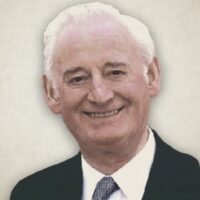
Benjamin Ramsbottom (1929-2023) was a Strict and Particular Baptist preacher. In 1967, he was appointed pastor of the church meeting at Bethel Strict Baptist Church, Luton, Bedfordshire, a position he held for fifty-five years.