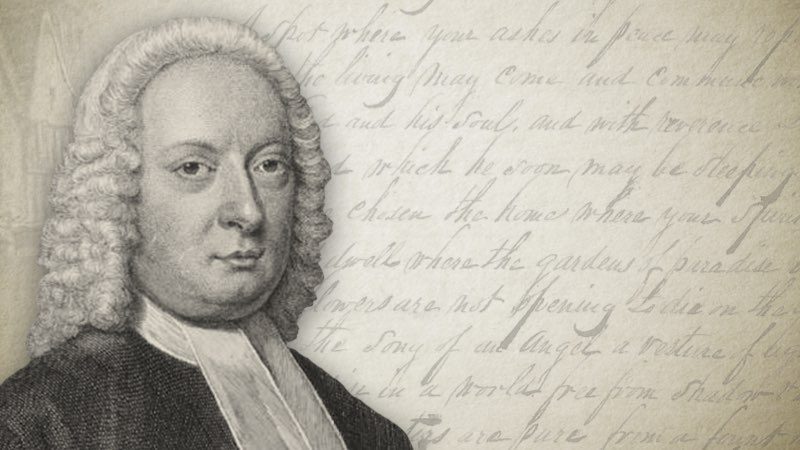
John Gill
John Gill (1697-1771) was a Strict and Particular Baptist preacher and theologian. He was appointed the Pastor of Goat Yard Chapel, Horsleydown, Southwark, serving this position for fifty-one years. He was the first Baptist to write an exhaustive systematic theology, setting forth High-Calvinistic views and a clear Baptist polity which became the backbone for the churches subscribing to them.
John Gill, (1) Commentary On First Thessalonians (Complete)
John Gill, (2) Commentary On Second Thessalonians (Complete)
John Gill, (3) Commentary On First Corinthians
John Gill, A Biography By George Ella
John Gill, A Lecture By George Ella
John Gill, Doctrinal And Practical Body Of Divinity
John Gill, Extracts
John Gill, Identifying The Biblical Covenants (Complete)
John Gill, The Cause Of God And Truth
-
1 Corinthians: Chapter 2, Verse 9
“But as it is written, etc.]” Not in an apocryphal book, called the Apocalypse of Elijah the prophet, as some have thought, but in (Isaiah 64:4) with some variation; and is brought to prove that the Gospel is mysterious and hidden wisdom, unknown to the princes of this world, and ordained before the world was, for the glory of the saints: for the following words are not to be understood of the glories and happiness of the future state; though they are indeed invisible, unheard of, and inconceivable as to the excellency and fulness of them, and are what God has prepared from all eternity, for all those on whom he bestows his grace here; but of the doctrines of grace, and mysteries of the…
-
1 Corinthians: Chapter 2, Verse 8
“Which none of the princes of this world knew, etc.]” Meaning not the devils, as some have thought, who had they known what God designed to do by the death of Christ, would never have been concerned in bringing it about; nor so much the political governors of the Roman empire, particularly in Judea, as Herod and Pontius Pilate, who also were entirely ignorant of it; but rather the ecclesiastical rulers of the Jewish church state, called hzh μlw[, “this world”, in distinction from abh μlw[, “the world to come”, or times of the Messiah; (see Hebrews 2:5) such as the priests, Scribes, and Pharisees, the Rabbins and learned doctors. These knew nothing of the wisdom of the Gospel, or the wise counsels of God…
-
1 Corinthians: Chapter 2, Verse 7
“But we speak the wisdom of God, etc.]” Not of men, not of the wise politicians, the learned philosophers and Rabbins; that which human wisdom has no hand in forming, nor in revealing, nor in propagating, and which is disliked and disapproved of by it: the Gospel is the sole produce of divine wisdom, and in which there is a glorious display of it; even in those doctrines which are the most charged with folly, as salvation by a crucified Christ, justification by his righteousness, pardon by his blood, satisfaction by his sacrifice, etc. “in a mystery;” It is mysterious wisdom. The Gospel is full of mysteries; there is the mystery of God, of a trinity of persons in the divine essence; the mystery of…
-
1 Corinthians: Chapter 2, Verse 6
“Howbeit we speak wisdom, etc.]” Though the wise philosophers among the Gentiles accounted the Gospel foolishness; and though the apostle, by an ironical concession, had called the ministry of it the foolishness of preaching, and the foolishness of God, and had thought best, for wise reasons, to deliver it in a plain and simple manner, without the embellishments of human wisdom; yet he vindicates it from the charge of folly: it was not folly, but wisdom, which he and his fellow ministers preached, and that of the highest kind, as appears from what follows. Though it was not esteemed so by all men, yet “among,” Or with “them that are perfect;” Adult, at age, opposed to babes and children; such who...
-
1 Corinthians: Chapter 2, Verse 5
“That your faith should not stand, etc.]” “Or be in the wisdom of men, but in the power of God”. The Spirit of God directed him, and he under his influence chose, and by his assistance pursued this way of preaching, with this view, and for this reason, that faith in Christ, and in the doctrines of his Gospel, which comes by hearing, might not be attributed to the force of human eloquence and oratory; or stand upon so sandy a foundation, as that which might, if that was the case, be puffed away by a superior flow and force of words; but that it might be ascribed, as it ought to be, to almighty power, stand in it, be supported by it, and at…
-
1 Corinthians: Chapter 2, Verse 4
“And my speech, and my preaching, etc.]” As he determined, so he acted. As the subject matter of his ministry was not any of the liberal arts and sciences, or the philosophy and dry morality of the Gentiles, but salvation by a crucified Christ; so his style, his diction, his language used in preaching, “was not with enticing words of man’s wisdom;” With technical words, words of art, contrived by human wisdom to captivate the affections; and with bare probable arguments only, a show of reason to persuade the mind to an assent, when nothing solid and substantial is advanced, only a run of words artfully put together, without any strength of argument in them; a method used by the false teachers, and which the…