George Ella
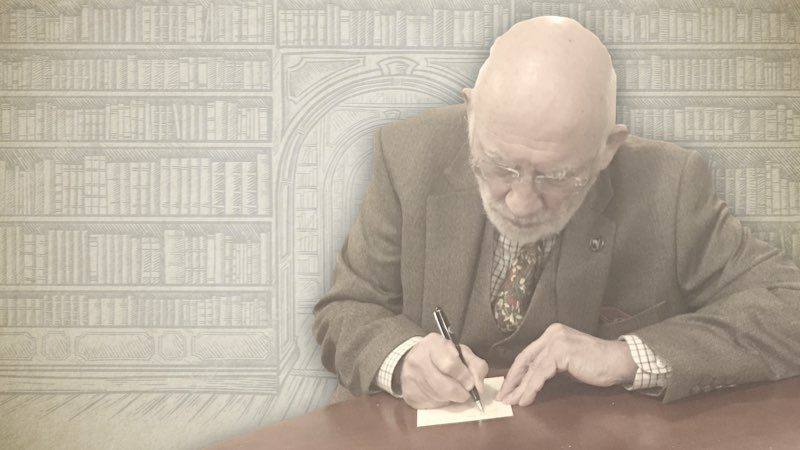
George M. Ella, born February 1939 in Yorkshire, England, has lived most of his life on the European Continent. He is a retired Senior Civil Servant formerly employed in teaching, post-graduate teacher-training, chairing examination boards and curricula work. He holds degrees from London, Hull, Uppsala, Essen, Duisburg and Marburg universities with doctorates in English Literature and Theology. Dr. Ella has written regularly since the seventies for a number of magazines and newspapers and published numerous books on Church History, including biographies of William Cowper, William Huntington, James Hervey, John Gill, Augustus Montague Toplady, Isaac McCoy and Henry Bullinger besides works on doctrine and education. He is currently finishing the third volume of his series 'Mountain Movers'; a biography of John Durie; a work on Law and Gospel and further study material for the Martin Bucer Seminar. Dr. Ella is still internationally active as a lecturer and is a Vice-President of the Protestant Reformation Society. He is keenly interested in missionary work and has written on the spread of the Gospel amongst the Same people of Lapland, the people of India and the Native Americans. This present volume follows Dr. Ella's 'The Covenant of Grace and Christian Baptism', also published by the Martin Bucer Seminar. George Ella is married to Erika Ella, nee Fleischman, a former government administrator, and they have two sons Mark (41), Director of a Polytechnic College in Bremerhaven and Robin (39), Leading Senior Physician in a newly-built Geriatric and Psychiatric clinic in Dessau.
George Ella on Doctrinal Matters
George Ella's Biographical Sketches
-
Duty Faith and the Protestant Reformed Churches
Dear Brother J., Thank you so much for your detailed analysis of my attempt to illustrate saving faith as opposed to duty-faith. You brought many coals to Newcastle for me and your Athens-bound ships were full of wise old owls, all of which were welcome. It is good to find that though you may disagrees with me on terms, we have so very much agreement on contents, though we are only at the beginning of a debate. It is very obvious that you Presbyterians use many words that I do, yet with different meanings. Thomas Scott used to say that all denominations tend to inject their own particular meaning into words and thus distinguish themselves from others. This is a true observation but it makes…
-
Preachers Today
Throughout last year, there was a rather one-sided debate in the internet concerning the alleged difference between preachers in pan-Biblical times and those of today. These were mostly carried out by para-church groups who had words such as ‘spiritual’ in their titles and were obviously against a settled ministry in a local church, some even arguing that the office of a preacher was only used of a peripatetic, itinerant servant of God. On most of these sites one found that the writers denigrated all modern preaching, presenting themselves, of course, as ‘spiritual’ preachers who were the exception to the sad rule. The result of this campaign was that a number of brethren copied quotes from these sites and sent them to various brethren, often without…
-
Substituting Fable For Historical Truth
A marked negative feature of common-grace gospellers is the scorn which they pour on men of God who emphasise that the whole gospel must be preached to the whole man as the Spirit leads. Thus they condemn such Christians of the past as Tobias Crisp, John Ryland Senior, William Romaine, William Huntington, John Gill, Augustus Toplady and Robert Hawker who would not dilute their gospel to suit what the common-grace gospellers call ‘man’s agency’. These men were called to preach Christ’s victorious crucifixion accomplishments, including great Bible truths such as the eternal union of Christ with His Bride; Christ’s faith and righteousness imputed to His people, election, predestination and the justifying, saving decrees of God in and from eternity and a faith which endures. Common-grace…
-
Tom Nettles Versus George Ella On Fuller
Having been of quite another opinion than The Founders Journal so often about what I believe and disbelieve and having met their ill-founded and quite misleading arguments to a large extent in various articles and books, I was surprised to read an online article today (20.10. 2014) by Tom Nettles, originally published in Issue 53 of the Founders Journal for 2003 and entitled ‘Jonathan Edwards: An Appreciation’, containing a doubly mistaken report appertaining both to myself and Andrew Fuller. I had obviously missed this at the time it was written. In Nettles’ article, the author creates an effigy of wax to stick pins into which he gives my name in order to create an Andrew Fuller after his own heart. Bad as I believe Fuller’s…
-
Fuller and His Thirst for Theological Reading
This afternoon (12.11.2020), I received an article which Michael Haykin had uploaded to Academia.educ who kindly sent me a copy. The 17 paged article with seven pages of endnotes affixed is entitled ‘A Great Thirst for Reading’: Andrew Fuller the Theological Reader’. As Haykin has been promising new information on Fuller’s life, ministry and theology for many decades, I am always curious on receiving anything from Haykin’s pen concerning new insights on Fuller as he has daily contact with Fuller’s records. Nobody is in such a fine position to do this work. Haykin is a university Professor of Fullerite Teaching and has every opportunity to spend his time researching Fuller assisted by a staff of scholars and an extensive library. Sadly, there was nothing new…
-
The Works of Andrew Fuller with a Biography (Part 2)
The Works of Andrew Fuller with a Biography by the Editor Andrew Gunten Fuller A Banner of Truth Trust Facsimile Reprint Part Two The bulk of BOT publications between the late nineteen-fifties and mid-eighties were a great support to the churches. Since then the BOT have lowered their standards to meet a wider readerships and have bowed to popular demands for less solid doctrines. Surprisingly, this broadening of views has led to the BOT adopting a narrow, intolerant, party spirit against those who refuse to take their lead. With their reprint of Andrew Fuller’s works, the BOT have now abandoned Reformation teaching altogether, giving their readers a philosophy of religion which appeals to the fallen human heart and mind. Fuller based his gospel on the…